What AI Can and Cannot Do for Toy Train Collectors
By Dr. Gleb Tsipursky Fall 2026 e*Train
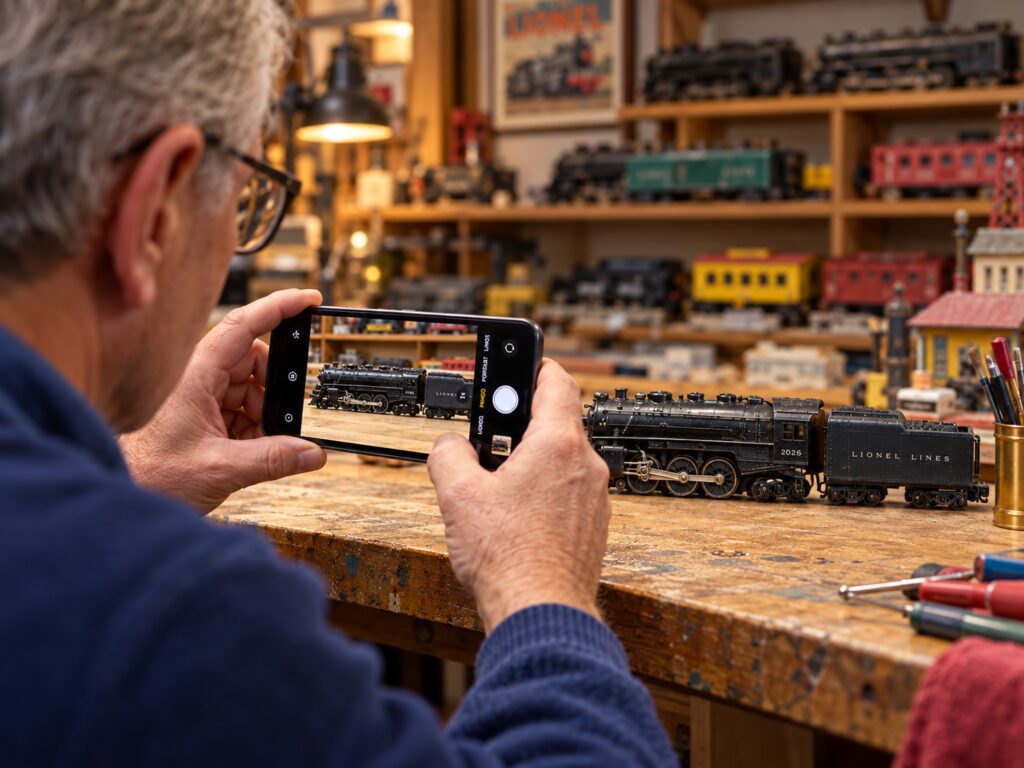
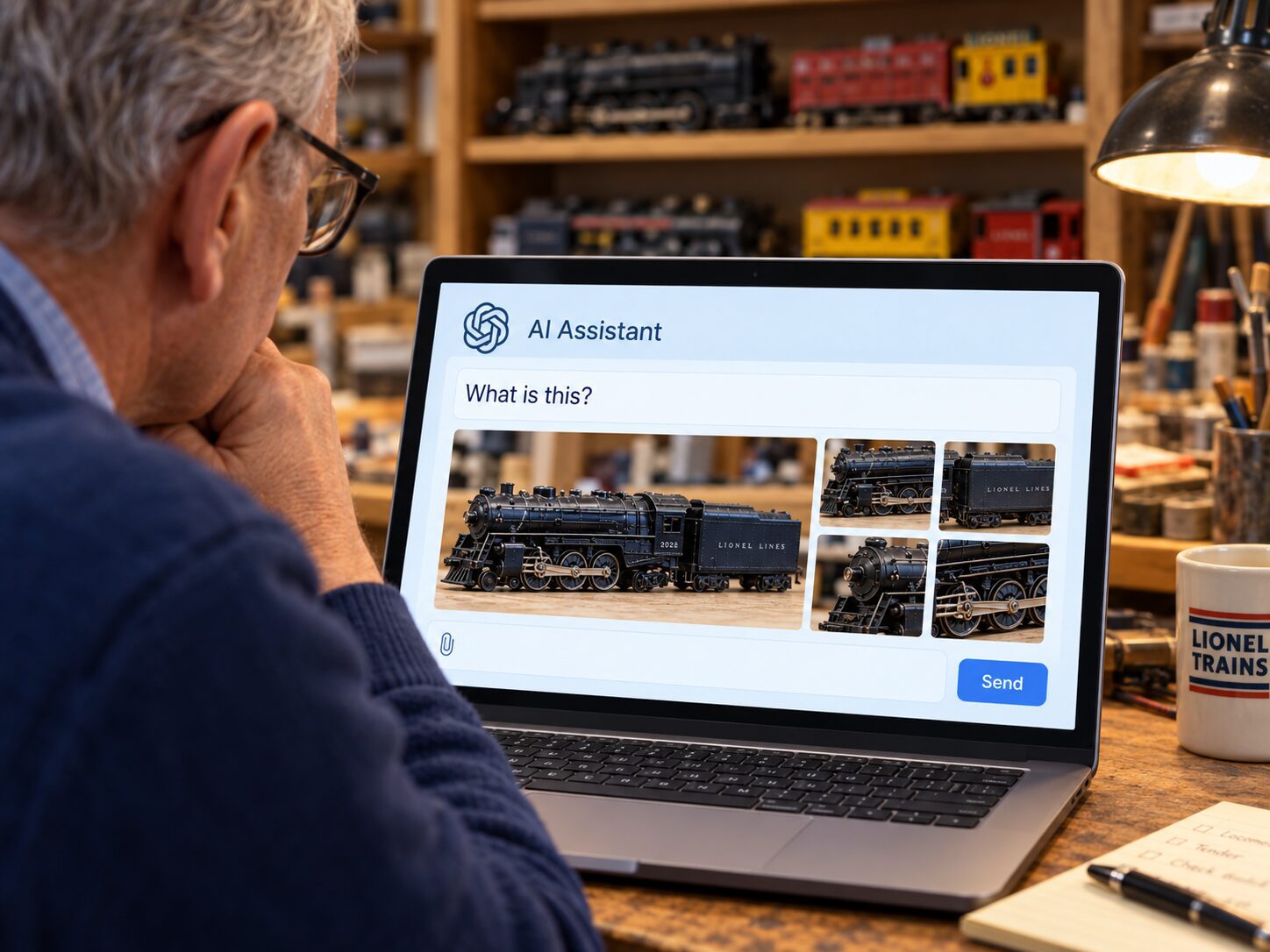
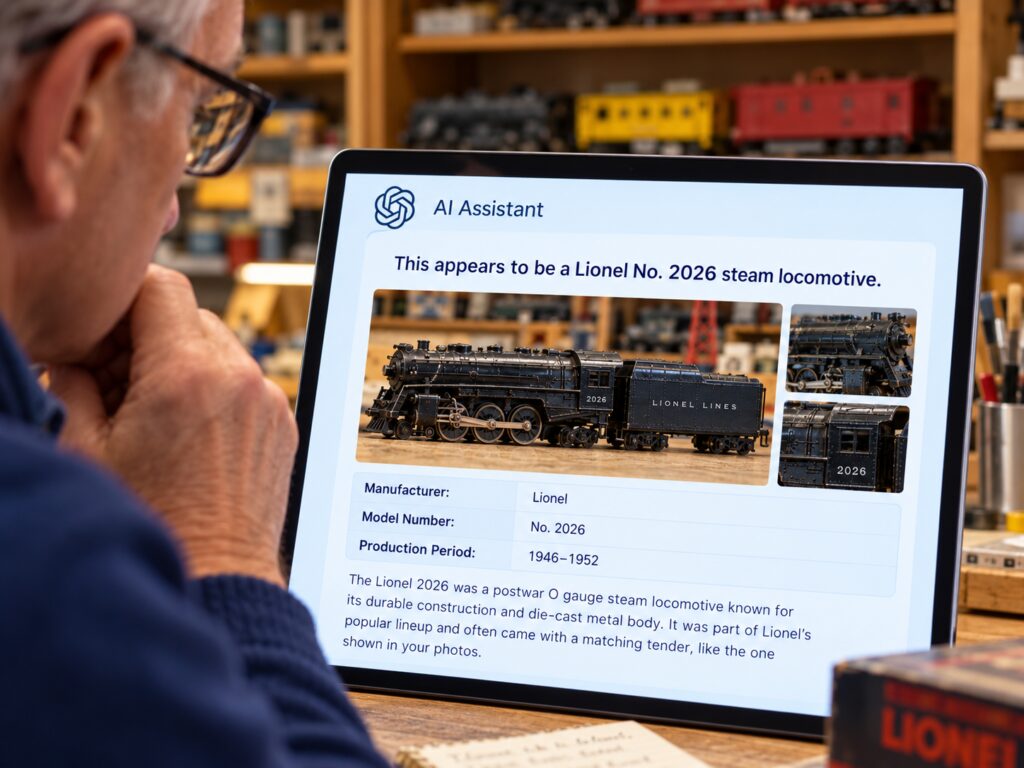
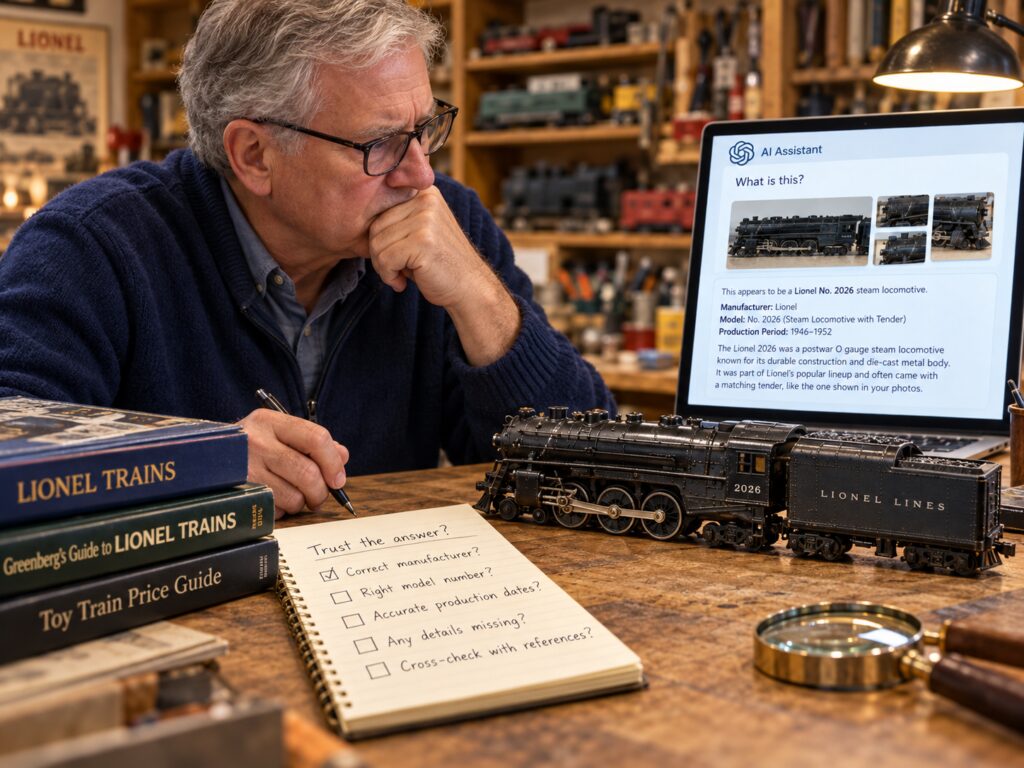
A collector photographs an unfamiliar locomotive, uploads the pictures to an artificial intelligence tool, and asks, “What is this?” Within seconds, the tool offers a manufacturer, model number, production period, and confident explanation. The answer sounds authoritative. It may even be correct. Yet for toy train collectors, the useful question is not whether AI can produce an answer quickly. The useful question is whether the answer deserves trust.
AI works best in the train room when we treat it as a fast, enthusiastic assistant with no collecting reputation to protect. It can help us notice details, organize information, read difficult documents, and generate better research questions. It can also invent model numbers, confuse similar variations, misread markings, and present guesses as facts. The collector must remain the engineer.
Start With What the Tool Can Actually See
Modern tools can accept photographs and analyze visible objects, labels, documents, and details. That makes AI image identification tempting for anyone facing an unfamiliar engine, car, accessory, box, or catalog page. The same official guidance warns that unclear images reduce accuracy and that the tool can produce incorrect descriptions.
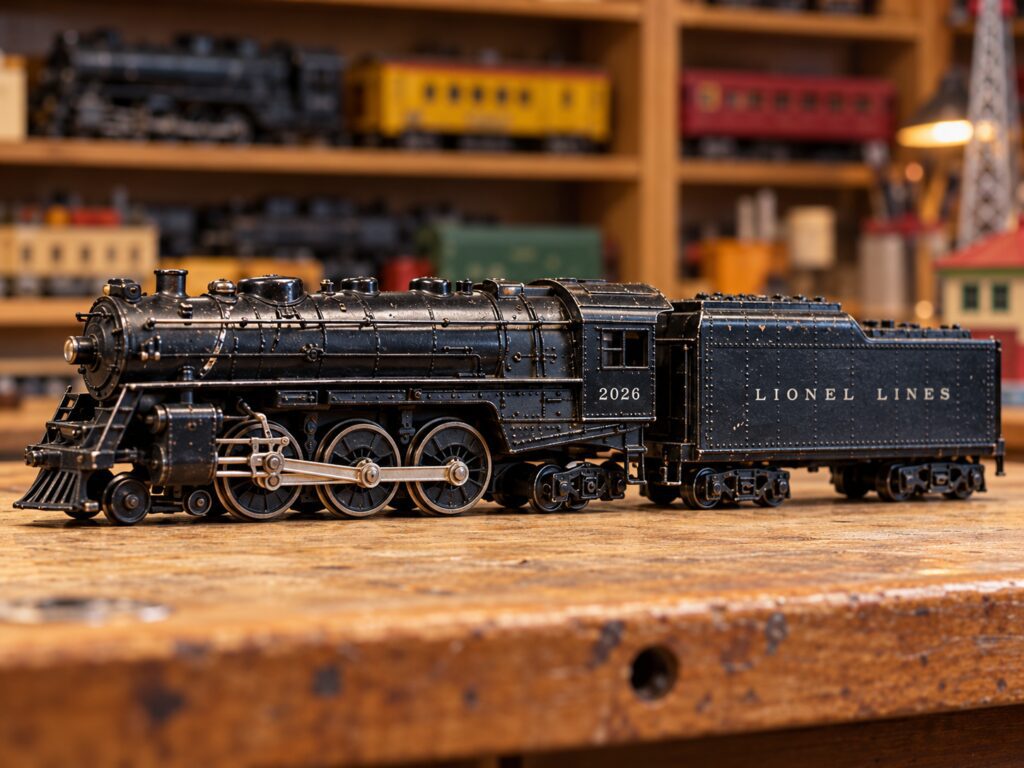
Give the tool a fair test. Photograph the item from several angles. Include the underside, couplers, trucks, wheels, stamping, lettering, body seams, screws, and any box labels. Add a ruler only when size matters, and tell the tool the gauge if you know it. Avoid a single distant photograph taken under poor lighting. A collector would hesitate to identify an item from that evidence, and AI should receive no special exemption.
Then change the first question. Instead of asking, “What is this?” ask:
“List every visible marking, number, mechanical feature, and construction detail. Separate what you can see from what you infer. Mark every uncertain reading as uncertain.”
That prompt forces the tool to begin with observation. You can then ask it to suggest two or three possible identifications and explain which visible details support or contradict each one. This approach turns AI into a second set of eyes rather than a self-appointed authority.
Use AI to Open the Research Door
Collectors often own boxes of old catalogs, instruction sheets, advertisements, receipts, correspondence, and handwritten notes. AI can help extract names, dates, product numbers, and searchable text from those materials. The National Archives describes machine-generated transcription as useful for search and access while cautioning that it is not always accurate.
That balance matters. Ask AI to transcribe a catalog page or handwritten note, but compare the result with the original. The National Archives still requires human review of extracted text, especially when a page includes faded ink, stamps, bleed-through, cursive, or mixed typefaces. Old train paper presents many of the same challenges.
Once you have checked the transcription, AI can help create search terms. It might identify a manufacturer name, product number, road name, slogan, or date that gives you a better starting point in the National Toy Train Library’s collections. This is where AI can advance the preservation of toy train history without pretending to replace the library, sources, or knowledgeable members.
A strong research prompt might say:
“Using only the text I provided, list the exact names, dates, model numbers, and phrases that I should search. Do not add historical claims. Give me a separate list of questions that the document does not answer.”
That last sentence matters. Good collecting research depends as much on recognizing missing information as on gathering available information.
Let AI Do the Clerical Work
The least controversial use may also save the most time. AI can help turn notes into train collection records, create tables, standardize column names, find blank fields, and reorganize spreadsheets. A collector can provide a list of items and request columns for manufacturer, catalog number, road name, gauge, era, condition, box status, purchase date, purchase source, and location.
Keep the source record intact. Ask AI to place uncertain entries in a separate review column rather than filling blanks with guesses. Preserve photographs, receipts, seller descriptions, and prior-owner notes outside the AI-generated summary. The summary should point back to evidence, not become the evidence.
AI can also draft plain-language labels for a home display, club exhibit, or family inventory. Give it verified facts and impose a strict rule: “Use only the information below. Do not infer dates, rarity, value, or historical significance.” That constraint produces a more useful label and makes errors easier to spot.
Draw a Hard Line Around Authentication and Grading
Do not ask AI to make the final call on authenticity, restoration, grading, or value. TCA’s grading standards promote common terminology and proper identification of restored, refinished, reproduction, and original items. Those judgments depend on evidence, inspection, experience, and context that a photograph or short description may fail to capture.
The same caution applies to collection authentication. TCA members commit to represent items accurately and identify restorations or reproductions appropriately. An AI answer does not transfer that responsibility to the software. The person describing, selling, or documenting the item still owns the claim.
AI may help prepare for expert review. Ask it to create a checklist of questions: Are the wheels, trucks, couplers, screws, paint, lettering, wiring, and box consistent with the proposed identification? Which details require an in-person inspection? Which claims need a catalog, reference book, or comparison item? The checklist can sharpen the conversation with an experienced collector without prejudging the result. That approach fits TCA’s own history, which began with collectors seeking answers about identification, variations, parts, and fellow enthusiasts.
Assume Confidence Can Be Misleading
General-purpose AI systems can generate false information while sounding certain. OpenAI’s own accuracy and limitation guidance warns about incorrect facts, fabricated references, and overconfident answers. The National Institute of Standards and Technology likewise treats confabulation and other reliability problems as risks that users must manage when applying AI hobby tools.
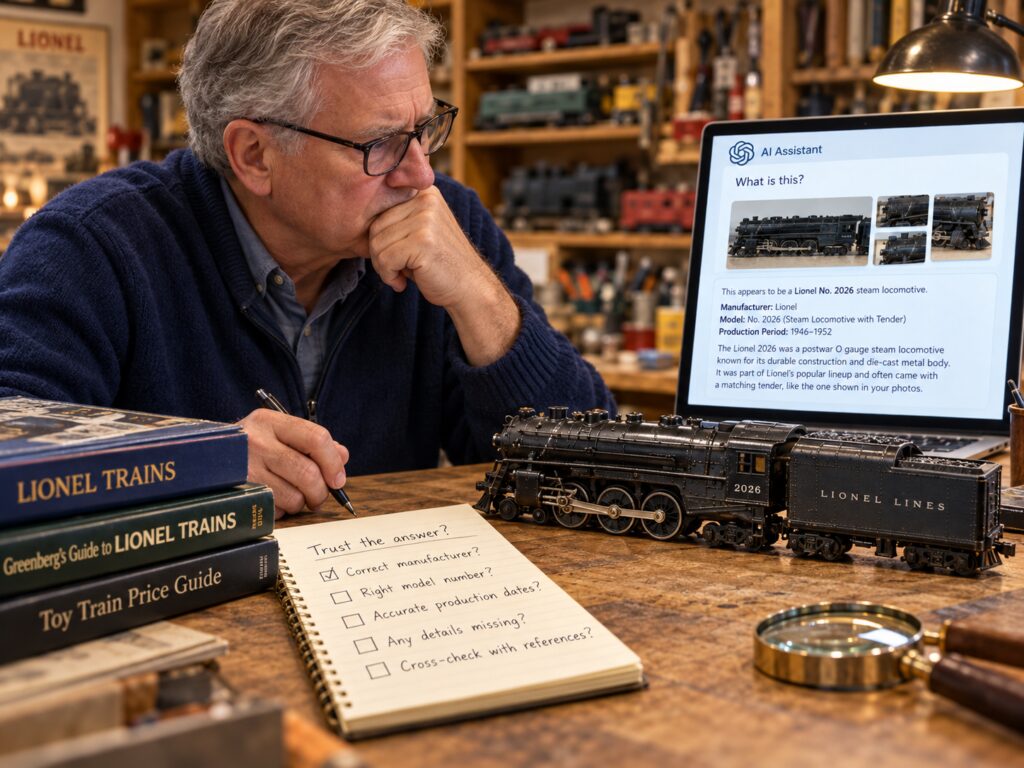
Three habits reduce the risk.
First, require the tool to separate observations, inferences, and unknowns. Second, ask for the exact source behind every historical claim, then open and inspect that source yourself. Third, challenge the answer: “What evidence would prove this identification wrong?” A tool that cannot provide verifiable support has offered a lead, not a conclusion.
Never accept a quotation, catalog reference, production date, rarity claim, or price history merely because the answer includes precise details. Precision can disguise uncertainty. When the stakes involve money, provenance, publication, or TCA standards, verify the claim through authoritative references and human expertise.
Protect Your Collection Information
A collection inventory may contain purchase prices, home locations, insurance information, receipts, account details, or photographs that reveal more than intended. Review the privacy settings of any tool before uploading sensitive records. For example, ChatGPT provides controls over model training and temporary chats, but collectors should still remove unnecessary personal information and understand the policies of the service they use.
Keep a clean working copy for AI assistance. Remove addresses, payment information, access codes, insurance policy numbers, and anything else the task does not require. Technology belongs in the train room only when it serves the hobby without exposing the collector.
Keep the Human Expert in the Cab
The TCA has long welcomed useful train room technology when it helps collectors operate, understand, and enjoy their trains. AI deserves the same practical test. Does it help you observe more carefully, organize evidence, preserve knowledge, ask better questions, or share the hobby more effectively? Then use it. Does it encourage shortcuts around expertise, provenance, standards, or fellowship? Apply the brakes.
The strongest approach to responsible AI adoption gives the machine repetitive and preparatory work while reserving consequential judgments for people. In the train room, that means AI can hold the flashlight, sort the notes, read the faded page, and suggest where to look next. The collector still identifies the destination.
—
Adapted from: The Psychology of AI Adoption at Work: From Resistance to Results (Georgetown University Press, 2026).
Dr. Gleb Tsipursky, a behavioral scientist called the “Office Whisperer” by The New York Times, helps tech-forward leaders stop overpaying for AI while boosting engagement and innovation. He serves as the CEO of the AI consultancy Disaster Avoidance Experts, and wrote eight books, including The Psychology of AI Adoption at Work: From Resistance to Results(Georgetown University Press, 2026).
Note: All images featured in this article were generated using artificial intelligence (AI).