Steel and Ingenuity: The Handcrafted Station That Time Forgot
By Robert M. English, TCA #96-43303 Summer 2025 e*Train
Back in the day, when wallets were thinner and times a bit leaner, model railroaders had to lean hard into their ingenuity and resourcefulness. Unlike today, where kits and laser-cut accessories can be found with a few clicks online, hobbyists of the past relied on their hands, their trades, and a good bit of imagination to bring their layouts to life. O Scalers earned an outsized reputation for creativity, transforming everyday household items into miniature marvels. What we now call “upcycling” was, back then, just common sense.
Picture this: it’s the early 1930s. You work in a metal fabrication shop—maybe in Chicago, St Louis, or Pittsburgh… or one of the many other great industrial cities. You’re no stranger to the hum of machines and the clatter of steel. After hours, the shop quiets down, but the scrap bin is full, and the tools sit warm. You’ve been given a few O gauge or Standard Gauge trains—perhaps a cherished hand-me-down from a friend or relative—but your layout is stark. No station, no platforms, no visual anchor to frame the action. You admire those beautiful Lionel or Ives stations in the catalog, but the price tag stops you cold. In 1935, a Lionel train with a platform cost you $26.00. That was more than a week’s wages for many—no small amount, especially during the tail end of the Great Depression.
So, what do you do? You build one.
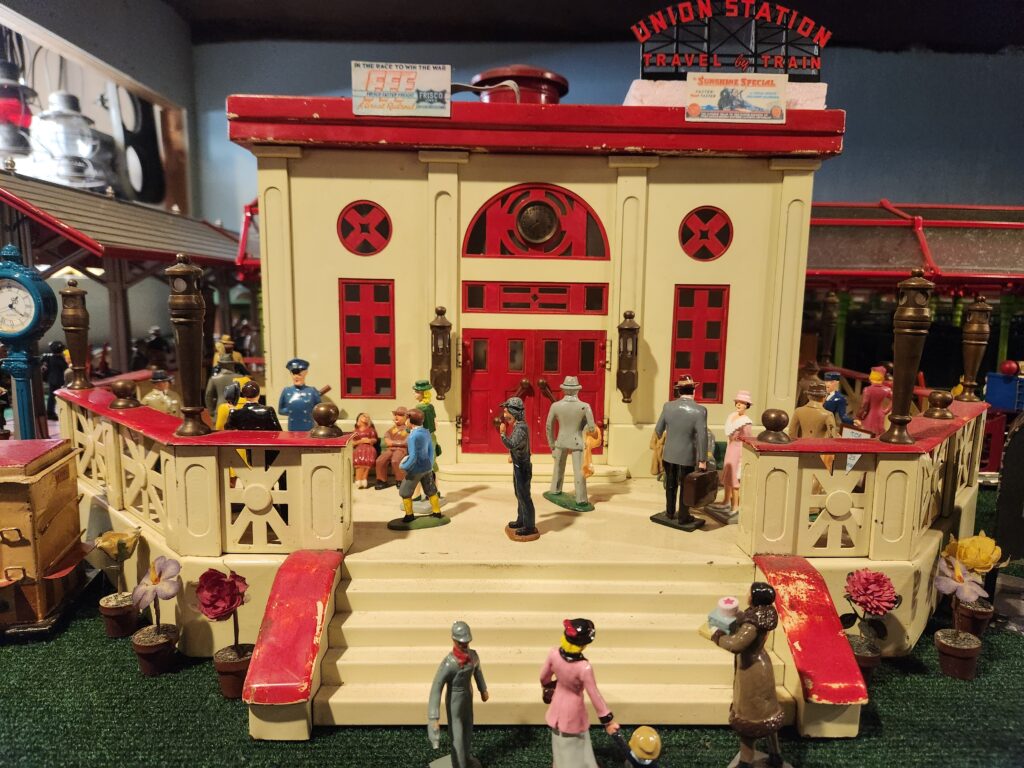
And not just any station. You build a real one—a station worthy of the trains that glide past it. You take steel from the scrap bin—thick-gauge, heavy stuff—and begin the process. You measure, cut, fold, and punch. Maybe it takes a few weekends, or perhaps you chip away at it over months. You rivet the panels together, bolt the corners tight, and even weld the key joints. This is no toy—it’s a handcrafted monument to precision and passion. The finished piece tips the scale at 45 pounds, every ounce of it speaking to your craftsmanship.
The design is thoughtful. The doors aren’t just cutouts—they’re hinged, multi-layered, with depth and character. The windows, too, are layered—stacked materials to create that dimensional look found in factory-made stations (mimicking the real thing!) of the era. You even make the lamps by hand, designing removable tops so bulbs can be replaced. And they’re wired and lit, just like the real thing. When it comes time to paint, you choose your colors carefully: a palette that nearly matches Lionel’s 115 and 116 passenger stations and the 155 freight platforms, realistic, and yet capturing the essence of the Lionel Station you admire so much. This station wasn’t made to just function—it was made to belong.
I’ve been the caretaker of this remarkable piece for the past twenty years. I bought it on a whim—one of those late-night deals that felt more like a rescue than a purchase. It came from a basement here in town, sold by a local who said it had been made in Chicago almost a century ago. There was no paperwork, no label, no maker’s mark—but the craftsmanship speaks volumes. This wasn’t a child’s project or a rough approximation. It was a piece of serious, skilled work, built by someone who knew metal and loved trains.
Every time I look at it, I wonder about the builder. Did they ride the elevated lines in Chicago, taking mental notes of the stations and architecture they passed? Did they build this station for their layout, or perhaps as a gift for a child or grandchild? Did they display it proudly in their living room or attic layout, or was it tucked away for years, forgotten until now?
These are the kinds of stories embedded in so many pieces from model railroading’s golden age. While mass-produced accessories have their place and plenty of charm, it’s these one-off, workshop-built relics that truly stir the imagination. They remind us of a time when necessity bred innovation and when craftsmanship wasn’t just about function—it was about pride, permanence, and the quiet joy of making something extraordinary out of nothing more than scrap and skill.
And so, I remain its caretaker. Not just of the object, but of the story it carries—silent, solid, and steadfast—waiting at the edge of the rails for the next train to come home.