Rail Rod
By John “Jessie” Stassen TCA #02-54892 Summer 2026 e*Train
This evening, I was working my way through some boxes at my mother’s home. She passed away over two years ago, and I am still desperately working to empty her house.
There are pictures from the 1800s, cups and saucers brought over from Germany by our forefathers, furniture, and even shaving utensils from Henry H., the mayor of Joliet. Recently, while in Savannah, Georgia, I listened to all of the history. Well, this is a small piece of my own history.
I see my ancestors in all of the cups, saucers, silverware, flute, smoking pipes, pictures, guitar, hats, a mirror, and so much more. But now, I am going to take you to “Rail Rod”—a small piece of my history.
Henry Stassen was a very successful man. He truly was the kind of person who would give you the shirt off his back. Even in 2026, I still hear stories about his legacy and how he helped so many people in their times of need. Just ask Caroline.
So here I am in my mother’s home, searching through boxes, discarding unwanted items, taking things to the thrift store, and giving possessions away. My mother would be so happy to know that we gave her medical bed to a man who attended her wedding and reception—Jim Hanrah, a good friend and a good man. He was a close friend of Henry and Carol, and it is a blessing that my mother is still able to help him when he needs it, even though she is no longer here.
By now, you have to be wondering what any of this has to do with the title “Rail Rod.” Well, we’re getting there.
Dad grew up poor. He came from the Depression era. His father, Emil (a deeply German name and, proudly, my middle name), took him to Chicago one Christmas from their home in Joliet. Henry looked into the windows at Macy’s, and there it was—a train set running endless loops. He was mesmerized.
Why?
When he was very young, he spent his summers at his aunt’s house in Monee, Illinois. The nights were hot, and when he couldn’t sleep in the parlor, he would walk out to the bridge over the railroad tracks. There, the coal-fired steam engines rested.
Thump… thump… sssshhhh… thump… thump… sssshhhh…
That is where he fell in love with the railroad.
His aunt would get upset because he stood on that bridge and let the smoke from the coal-fired engines drift up underneath him. When he went back to bed, the sheets would be covered in coal soot, and back then, they didn’t have washing machines.
His father simply couldn’t afford to buy him a train set. He was doing everything he could just to put food on the table and pay the mortgage.
So when Henry finally could afford it, he bought himself a train set. Then another. Before long, it had gotten completely out of hand.
We would go to TCA (Train Collectors Association) meets and come home with a box or two of trains every time. He truly was a connoisseur, knowing nearly every Lionel model ever made. We had a lot of fun, and the camaraderie among the other collectors was wonderful.
Of course, there was one collector everyone thought was the grandest of them all—Edward “Eddie.” He always had his 10-year-old son, Frankie, in tow.
The TCA did its best to engage the kids. They had free hot dogs, free cotton candy, and even gave away free trains.
One of the big meets was in Wheaton, Illinois. Around 1970, they came up with the grand idea of having a train drag race for the kids. Each child would bring an engine to race, and through elimination, there would be one winner, who would receive a $10 certificate to spend on any train item at the show.
They set up a two-lane track side by side using a Lionel ZW transformer. The track sat across eight church tables, with the final four sections of track left unpowered.
Of course, I wanted to race.
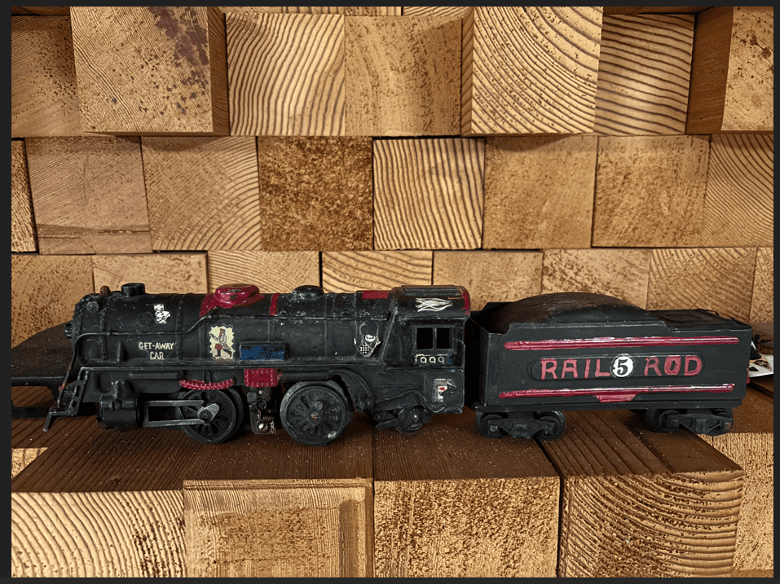
Dad picked out the lightest, fastest engine he could find—a simple Lionel Marx No. 999 with a 2-4-2 wheel arrangement. It wasn’t fancy, but Dad “souped it up” by giving it a fresh oiling and removing the running gear from one side. He was serious. He followed auto racing religiously and treated this little locomotive the same way.
Naturally, I added my own touch. I painted the dome red and decorated it with decals that read “Get-Away Car,” skull and crossbones, and “Rail Rod” on the tender.
When race day arrived, Dad gave me one instruction:
“Just throw the handle on the ZW all the way forward and don’t turn it off.”
The other kids showed up with beautiful, expensive locomotives. There I stood with my painted, decaled, inexpensive little engine.
Everyone was cheering for Frankie. He had the fancy locomotive, and his dad was proudly strutting around—after all, the whole race had been his idea.
Eventually, it came down to Frankie and me.
Dad quietly said, “Don’t worry. When your engine runs off the end of the tables, I’ll catch it.”
I don’t think he had ever been a baseball catcher, but that day, he certainly became the train catcher.
We beat Frankie by two full table lengths.
Eddie had an absolute apoplexy.
“It isn’t fair!”
“You can’t run off the tracks!”
“He had no tender!”
“His lane is faster!”
“I want a rematch!”
You would have thought it was the World Series.
Good grief.
So what did we do?
We raced again.
This time, I switched lanes, put the tender back on, and Dad caught both locomotive and tender as they flew off the end of the tables at full speed.
I really don’t feel sorry for Frankie.
We won fair and square.
Well, Frankie’s dad was so beside himself that they never held the race again. He claimed the kids just weren’t having any fun.
And guess what I found in a box this evening?
My “Rail Rod.”