The $20,000 Pyramid Boxcar
The History, Mystery, and Enduring Legend of American Flyer’s G. Fox Set
By Michael S. Oher, TCA #18-73531 Fall 2026 e*Train
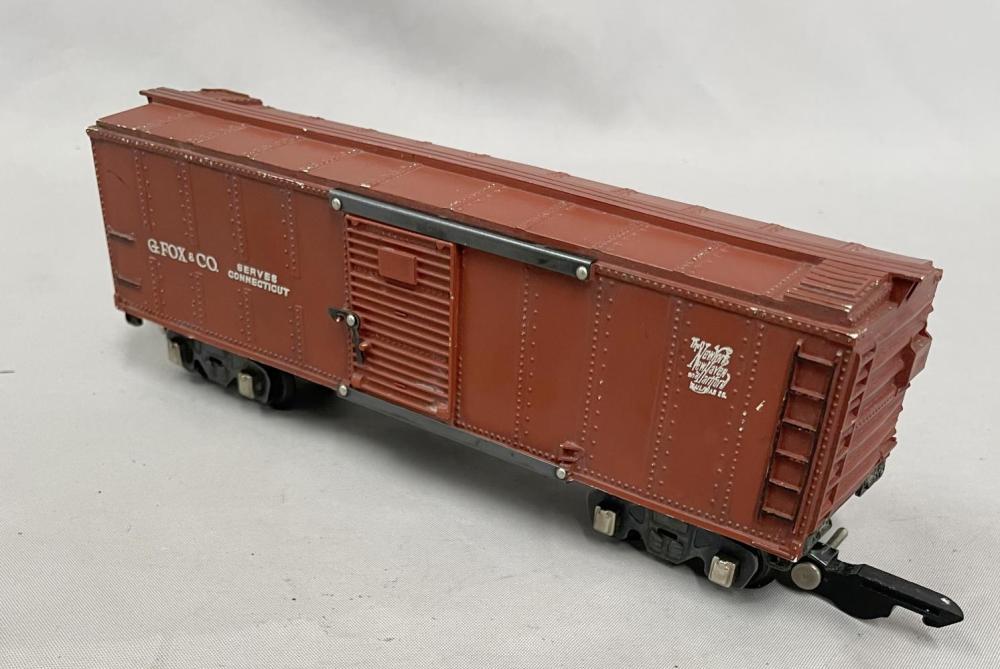
Every collecting hobby has an object that eventually becomes something more than the object itself.
For American Flyer collectors, one of those objects is a rather ordinary-looking Tuscan boxcar.
It has no whistle. No lights. No operating mechanism. Nothing pops out of it, unloads from it, or flashes as it rolls around the Christmas tree. At first glance, it could almost disappear into a long postwar freight consist.
Then you notice the lettering.
G. FOX & CO.
SERVES CONNECTICUT
And suddenly it isn’t just another boxcar.
It is the G. Fox boxcar.
For generations of serious Flyer collectors, those few words have been enough to stop conversations at train shows and send people digging through old auction catalogs. They lead backward into one of the most tantalizing corners of American Flyer history: a great Hartford department store, its 100th anniversary, an American Flyer display meant to make children dream, a special Gilbert outfit, an impossibly scarce billboard, a surviving set carton stamped for G. Fox itself, and a tiny population of original cars that have spent decades quietly migrating through some of the finest Flyer collections in the country.
There are reproductions.
There are fakes.
There are stories that can be documented.
There are stories that cannot.
And occasionally—just often enough to keep the legend alive—one of the real cars comes out of hiding.
That happened again in September 2026.
At Stout Auctions, an original No. 633F G. Fox boxcar reached $13,000. With a 19 percent online buyer’s premium, that works out to approximately $15,470, plus applicable sales tax and shipping.
For a boxcar.
And it wasn’t even the most expensive one.
But the money is really the least interesting part of the story.
To understand why adults will spend the price of a used automobile on one little brown freight car, we have to go back almost eighty years—to a time when a trip downtown could be an event, department-store windows were magical, and a toy train circling beneath the Christmas tree could be the most important thing in a child’s world.
Christmas at G. Fox and Co.
There was a time when the great American department store was almost a city within a city.
And in Hartford, Connecticut, that store was G. Fox & Co.
Its eleven-story downtown building was an institution. For generations of Connecticut families, G. Fox was more than a place to buy clothes, furniture, or Christmas presents. Especially during the holidays, the store itself was part of the occasion: decorated windows, crowded sales floors, toy departments, and children staring at things they desperately hoped might somehow appear beneath the tree.
Few things fit that world better than an electric train.
The A.C. Gilbert Company was just down the road in New Haven, and in the years immediately following World War II, American Flyer was entering the postwar era that would ultimately define the brand for generations of collectors.
G. Fox did not merely sell American Flyer trains.
It displayed them.
A remarkable photograph survives of the American Flyer sales area inside G. Fox, complete with an operating layout. The photograph later appeared in Gilbert’s 1948 D1511 display catalog and in Make Your Own Gilbert Hall of Science, where it served as an example of how a retailer could create an effective Gilbert display. The photograph is believed to date from 1947, a particularly important year in G. Fox history: the store was celebrating its 100th anniversary. According to the historical research preserved by American Flyer Displays & History, 1947 was also the year Gilbert issued the very rare G. Fox boxcar. American Flyer Displays & History — G. Fox Company
Look at that old photograph long enough, and the boxcar begins to feel less like an isolated rarity and more like a piece of a living place.
Imagine being a child standing there.
Trains are moving through miniature scenery. Locomotives circle the display. American Flyer equipment fills the sales area. Parents stand behind their children, perhaps already calculating whether one of those trains might somehow fit into the Christmas budget.
It was retail as theater.
And American Flyer was the show.
Somewhere in that world, while G. Fox celebrated a century in business, appeared a little brown boxcar bearing the store’s name.
Nearly eighty years later, collectors are still chasing it.
1947—and an Older Story
For years, another date has followed the G. Fox story around the hobby: 1946.
Long-standing collector history has sometimes placed the origins of the promotion around Christmas 1946, and later auction descriptions have repeated that date. There is also an old story among collectors that A.C. Gilbert was friendly with the owner of G. Fox and authorized the special promotional train through that relationship.
The friendship may be true, but I have yet to find contemporary correspondence establishing it conclusively. And the dating deserves the same caution.
The strongest evidence presently points to 1947.
American Flyer Displays & History & American Flyer reference books specifically identify 1947—the G. Fox centennial year—as the year Gilbert issued the boxcar.
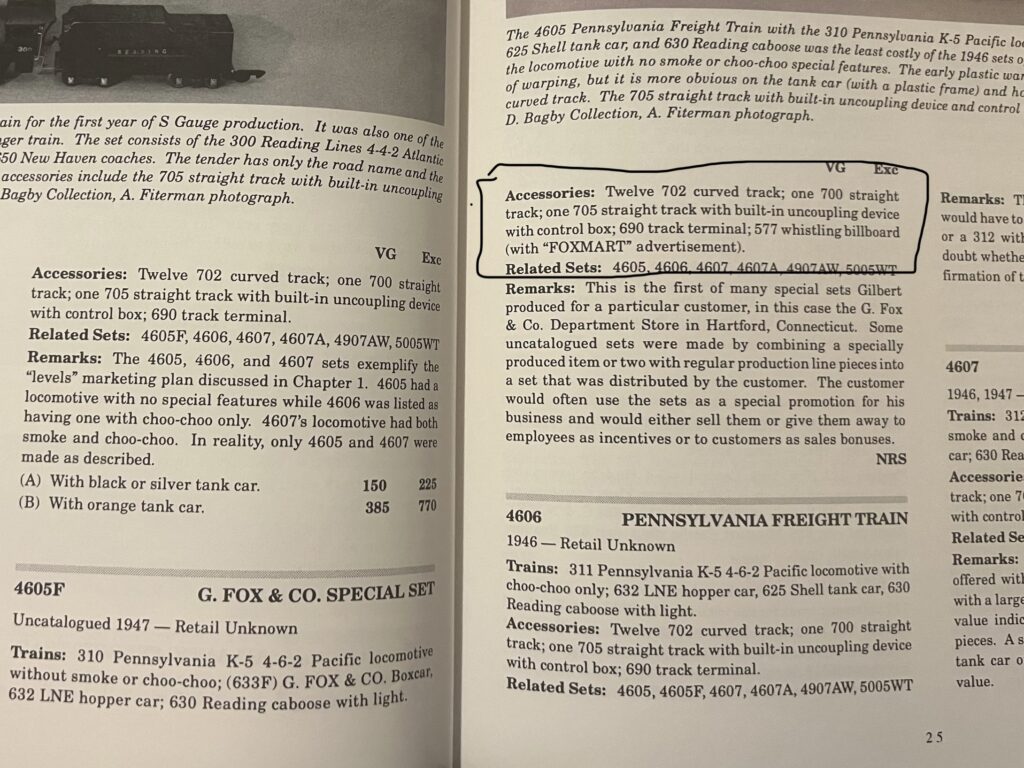
Al Weaver, writing more than forty years ago in the July 1983 Train Collectors Quarterly, independently described the G. Fox promotion as dating from “circa 1947.”
That does not necessarily make every reference to 1946 wrong. The promotion may have been conceived in 1946. The arrangement with G. Fox may have begun during the preceding Christmas season. Collector memories may have blended the origins of the promotion with the eventual appearance of the car.
And in a way, that makes the story better.
The G. Fox boxcar appeared as the company whose name it carried was celebrating its first hundred years.
It was a centennial boxcar.
“To G. Fox & Co.”
Fortunately, not everything about the story requires interpretation.
Because somewhere, nearly eight decades later, an original American Flyer set box survives with two particularly wonderful markings.
4605F.
And:
“To G. Fox & Co.”
There is something almost poetic about that old destination marking.
It is not a collector’s handwritten attribution added decades later. It is not an auction-house description. It is not folklore repeated across a table at York.
The box itself tells us where it was going.
To G. Fox and Co.
And the train associated with that box has a history almost as remarkable as the box itself.
The 4605F That Survived
The G. Fox story was already fascinating serious collectors more than forty years ago.
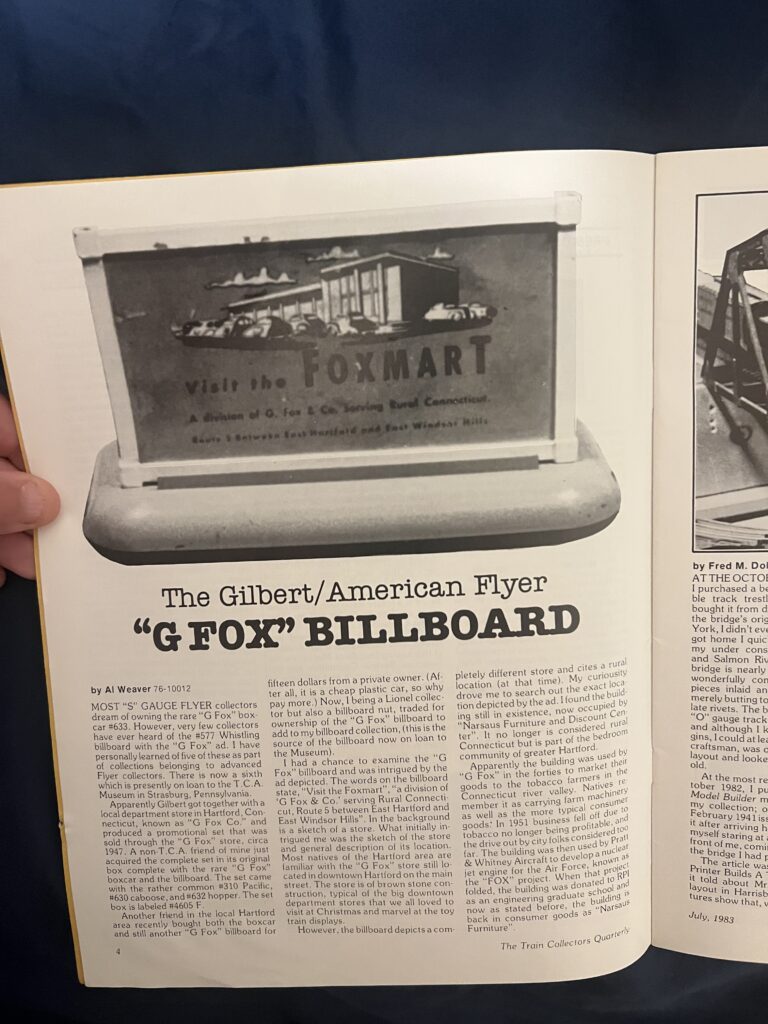
In the July 1983 issue of Train Collectors Quarterly, Al Weaver published an article titled “The Gilbert/American Flyer ‘G FOX’ BILLBOARD.”
His opening sentence tells us something important about the reputation the car already possessed:
“Most ‘S’ Gauge Flyer collectors dream of owning the rare ‘G Fox’ box car…”
Think about that.
That was written in 1983.
The G. Fox did not become legendary because the Internet discovered it. It did not become rare when somebody paid $18,975 for one in 2021. Serious Flyer collectors were already dreaming about finding one when most train collecting still happened through meets, club publications, telephone calls, letters, and word of mouth.
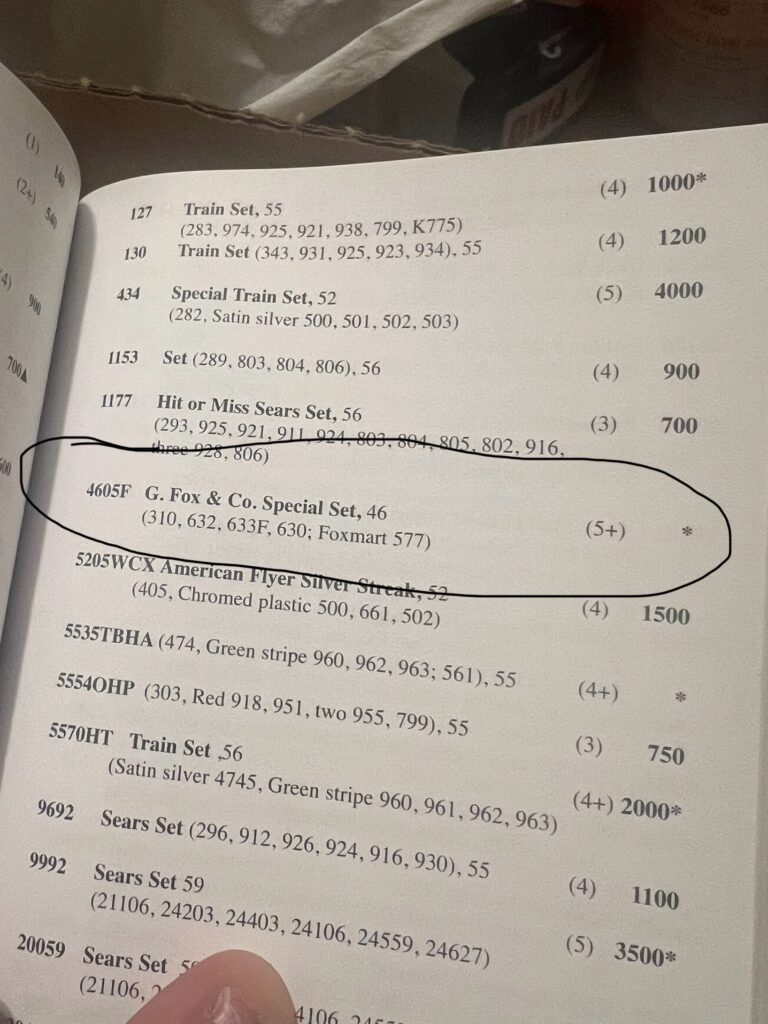
Weaver described a friend who had acquired what he considered the complete promotional outfit in its original box. The set box was labeled 4605F, and the train included a No. 310 Pacific, No. 632 hopper, No. 630 caboose, and the rare G. Fox boxcar.
And that particular set did not disappear after Weaver wrote about it.
Remarkably, the same collector described in 1983 still owns it today.
I have personally had the opportunity to examine it.
The collector wishes to remain anonymous, and I will respect that. But the set’s continued existence gives us an extraordinary thread of continuity.
It was significant enough to write about in 1983.
More than forty years later, it remains intact.
Its original box survives.
The 4605F marking survives.
And so does that wonderful destination marking:
“To G. Fox & Co.”
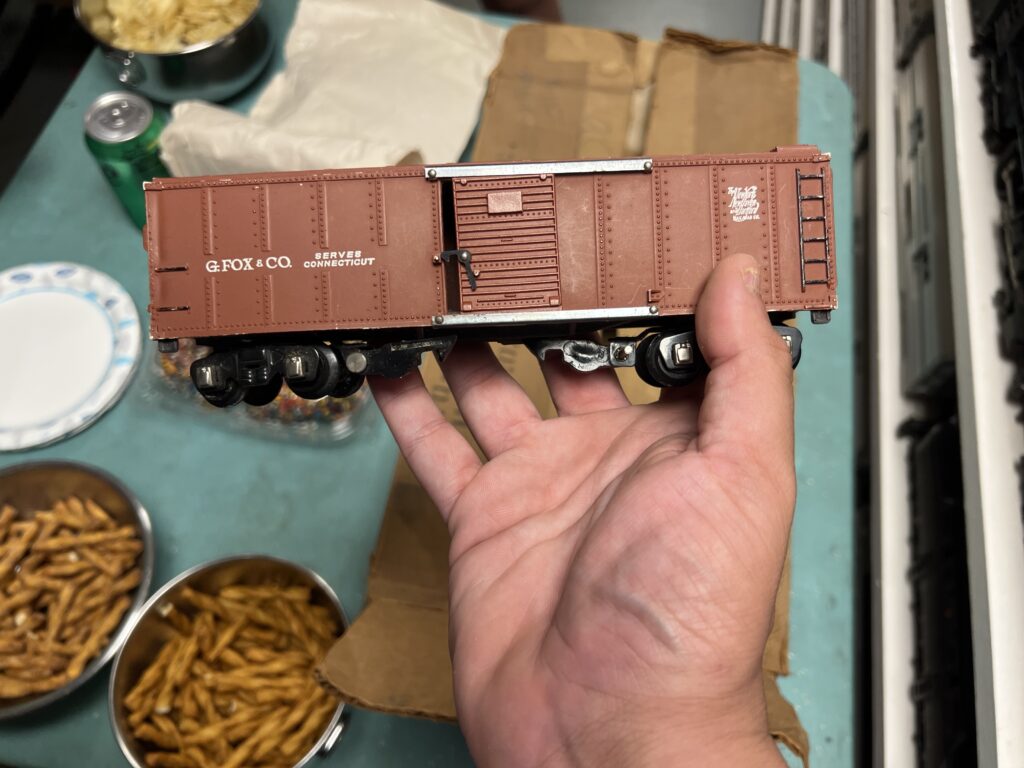
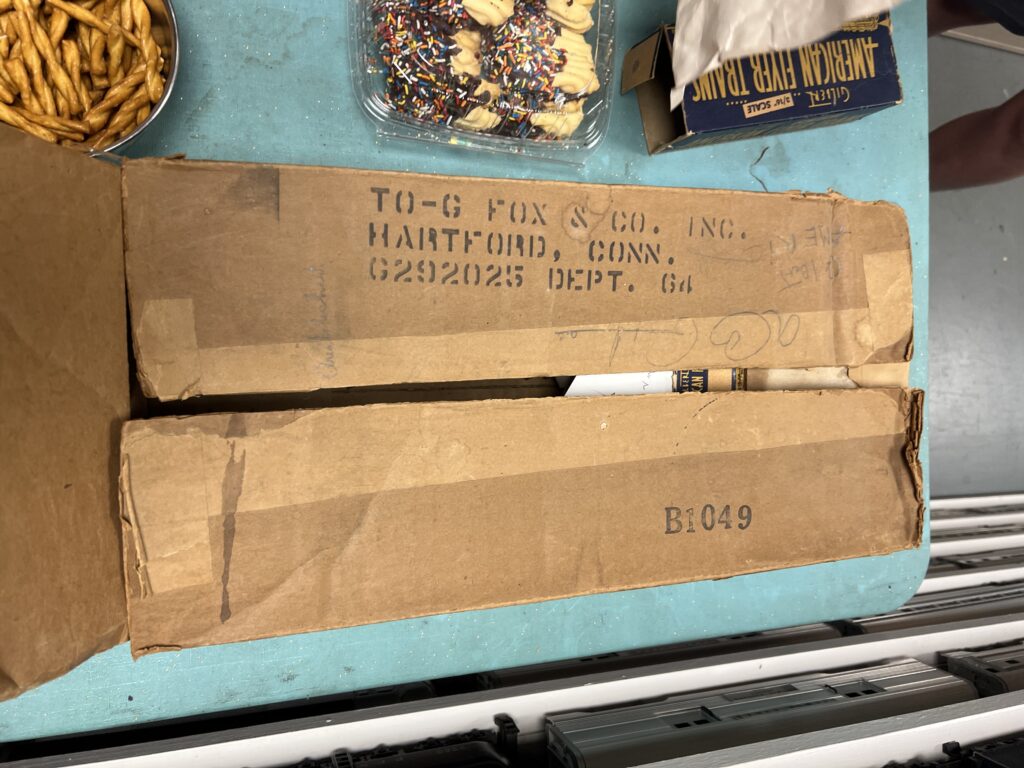
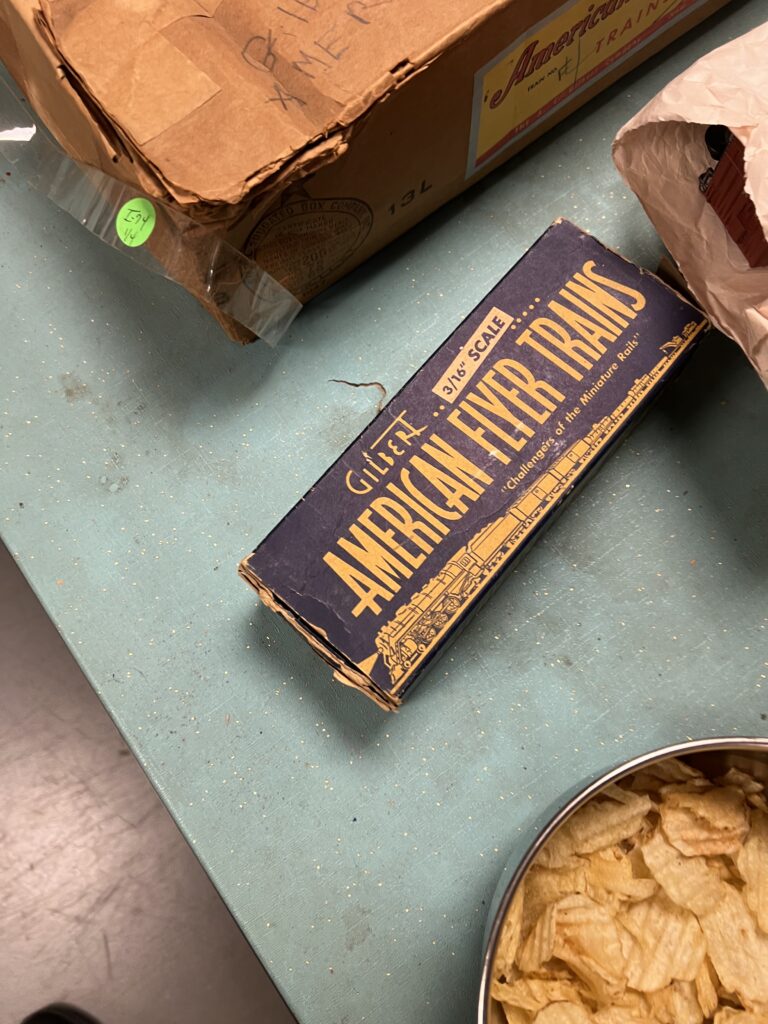
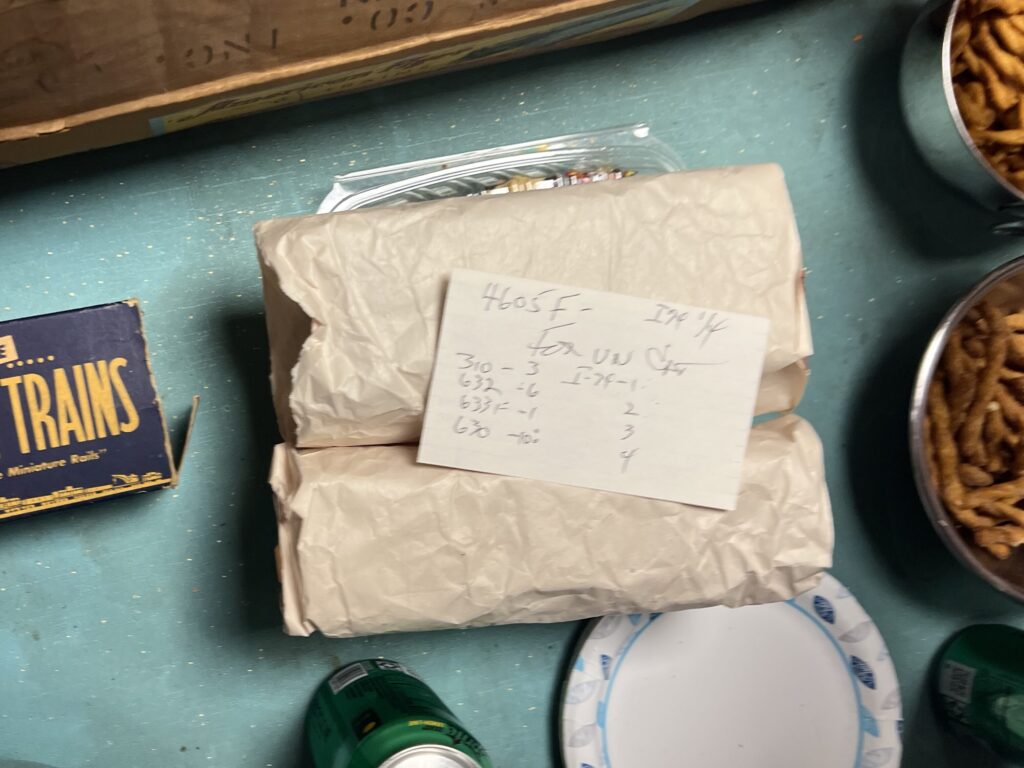
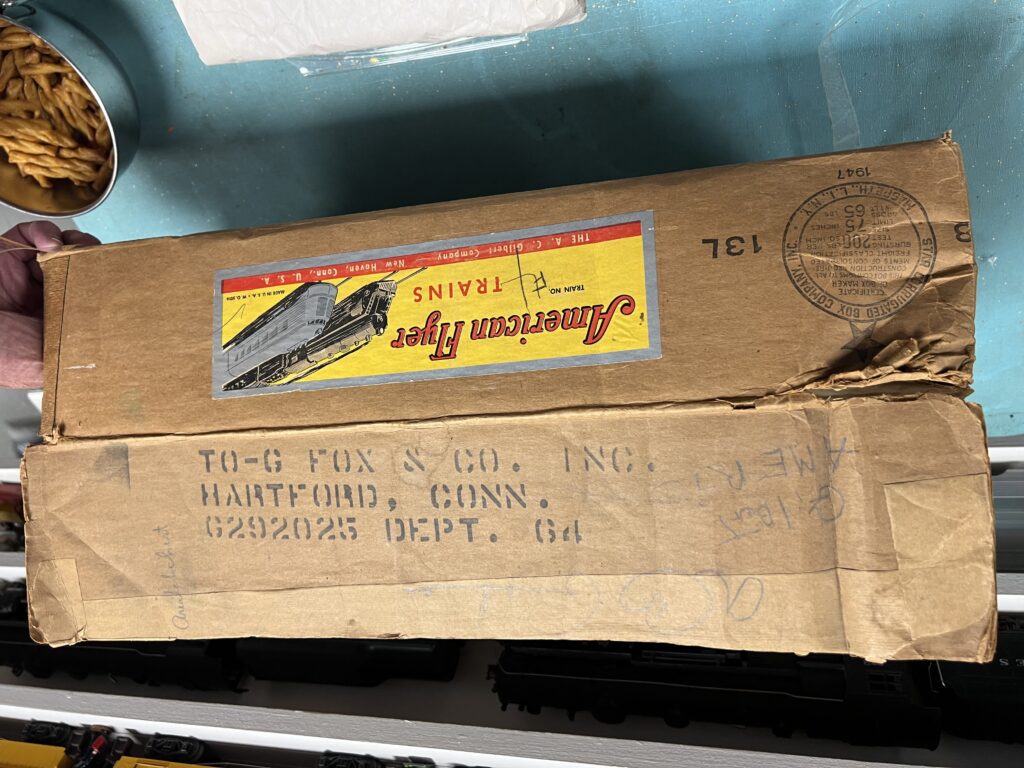
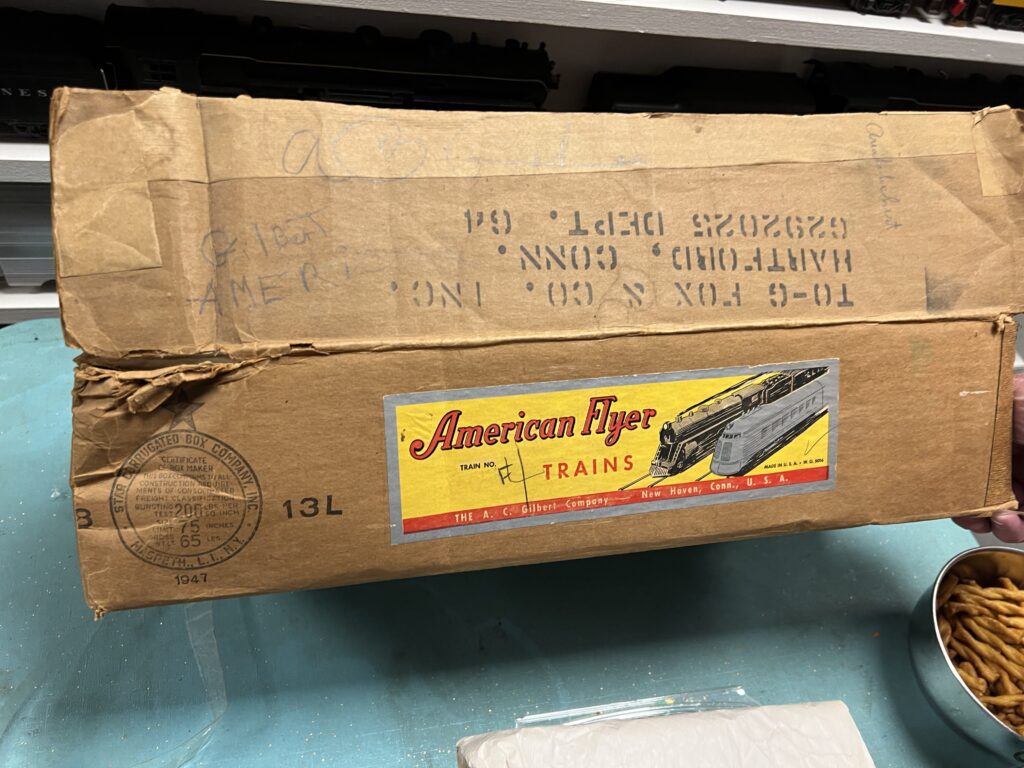
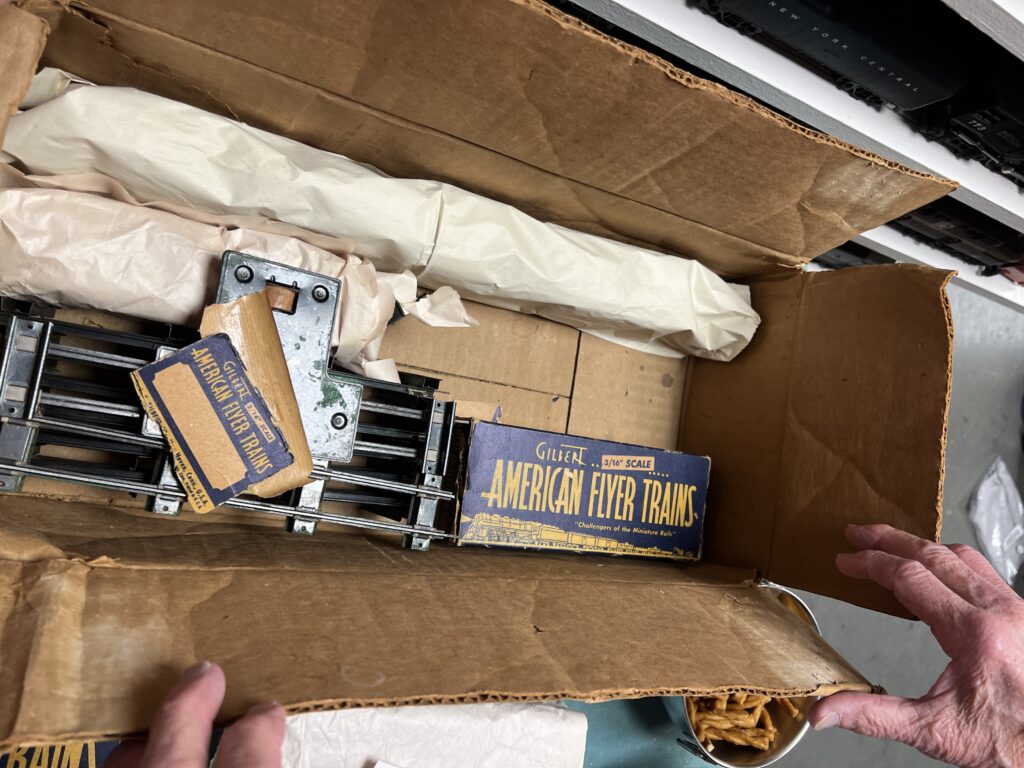
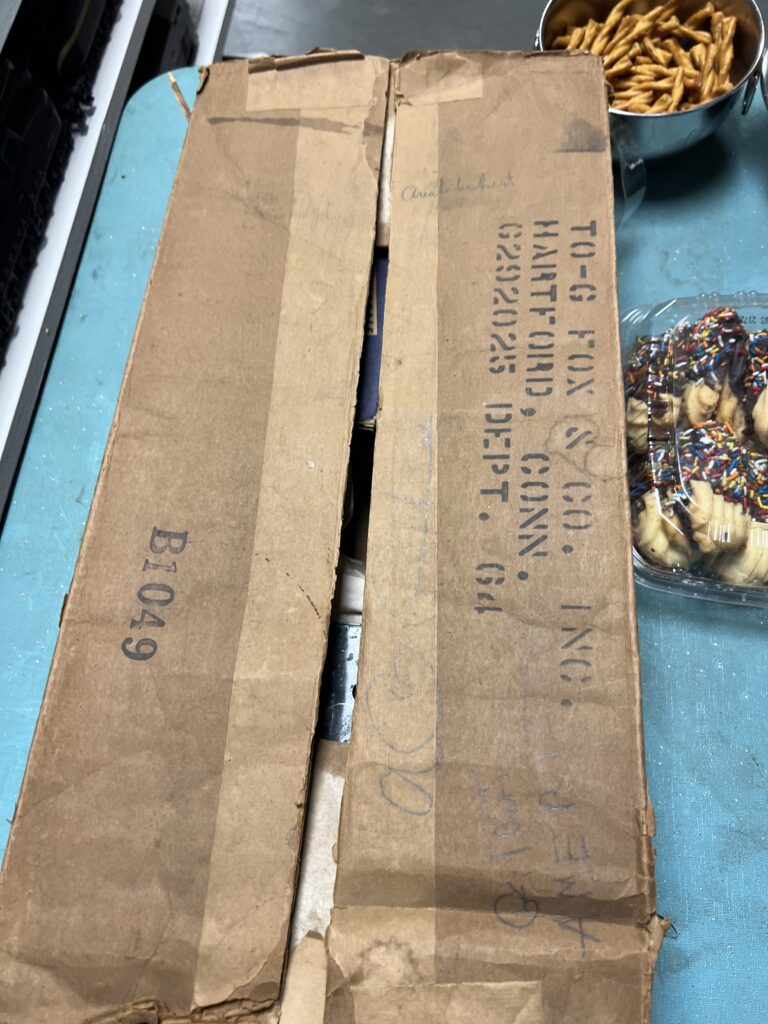
In all my years around American Flyer, it is the only complete original 4605F outfit I have personally seen.
That does not mean another one isn’t out there.
If this hobby teaches us anything, it is never to say never about what might be sitting in somebody’s basement.
There Was More to G. Fox Than a Boxcar
The G. Fox boxcar was not the only special Flyer item associated with the store.
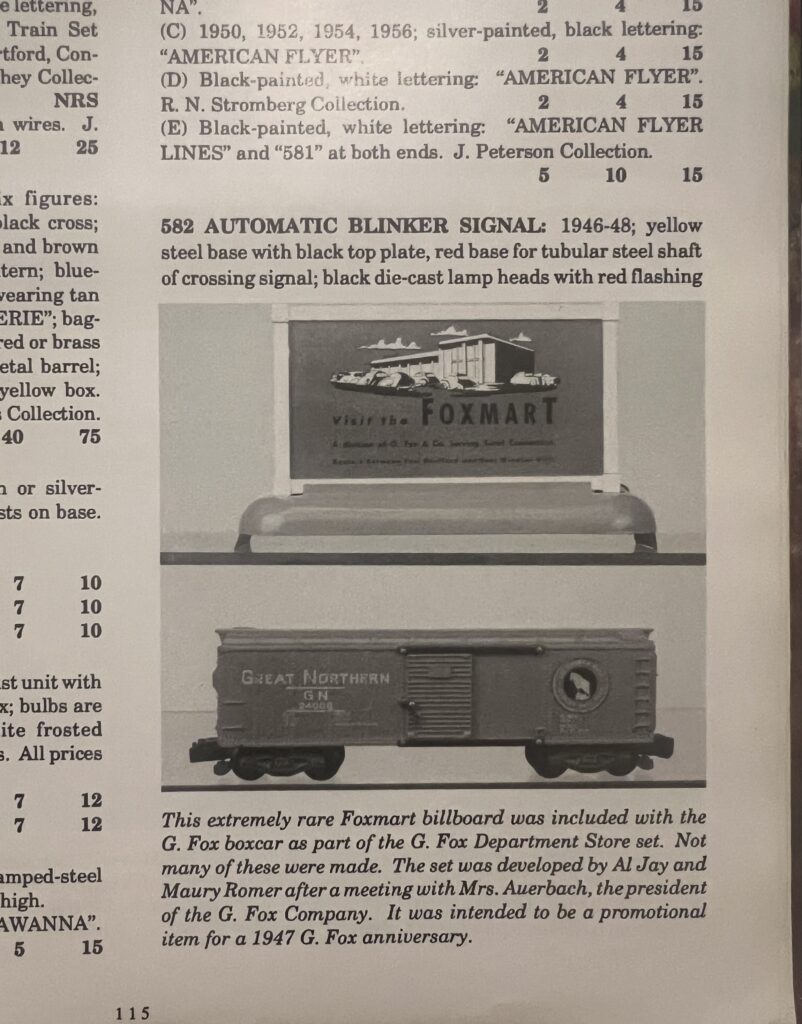
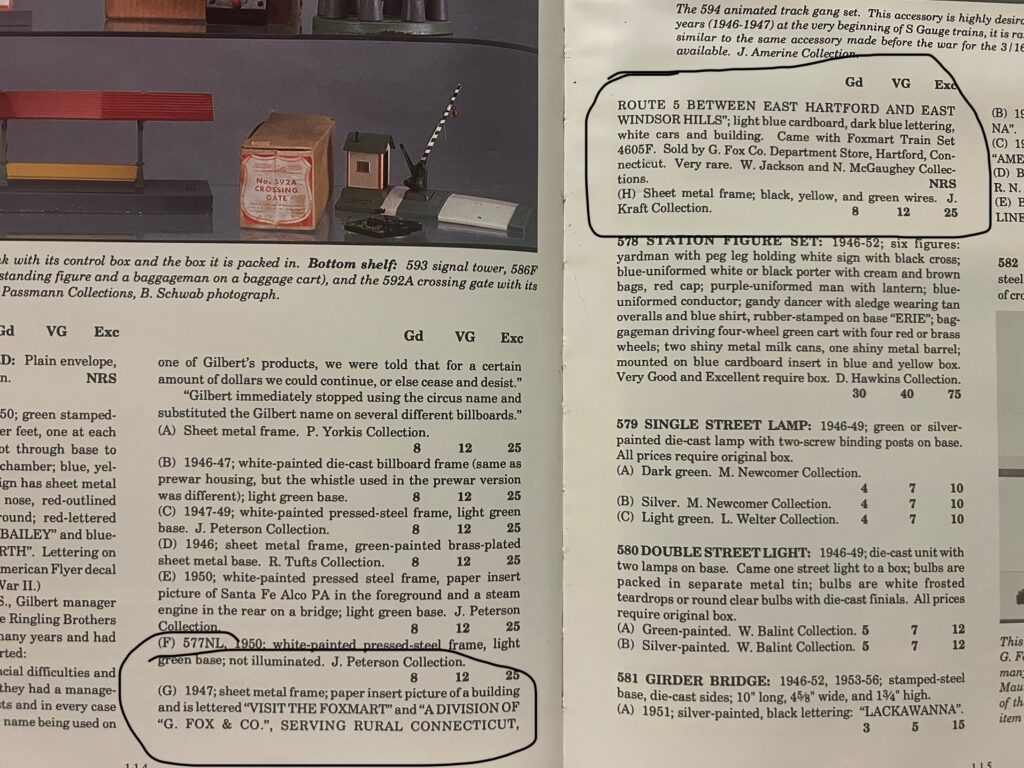
There was also an extraordinarily scarce version of American Flyer’s No. 577 whistling billboard, the 577F, advertising:
VISIT THE FOX MART
with the wonderful period tagline:
A Division of G. Fox & Co. — Serving Rural Connecticut
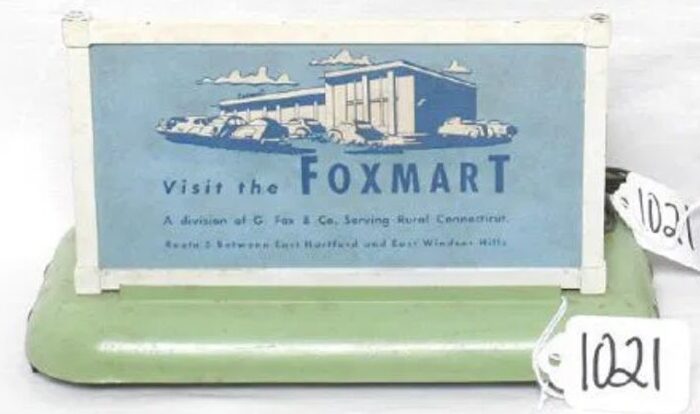
Instead of the great downtown Hartford department store, the billboard depicts a decidedly rural scene. Weaver connected it with G. Fox’s efforts to serve rural Connecticut, including communities in the tobacco-growing Connecticut River Valley.
It is a charming little piece of mid-century advertising—and by 1983, Weaver had already learned of only a handful.
He wrote that five examples were known in advanced Flyer collections and then identified a sixth associated with the TCA Museum in Strasburg.
Even better was the story of how one collector found his.
According to Weaver, a friend purchased both a G. Fox boxcar and another G. Fox billboard from a private owner for $15.
Fifteen dollars.
Today, fifteen dollars might buy you lunch at the train show.
Back then, apparently, it could buy you two pieces that Flyer collectors would spend decades chasing.
There may be no better illustration of the strange alchemy of collecting.
Today’s curiosity can become tomorrow’s Holy Grail.
But Did the Billboard Actually Come in the Set?
This may be my favorite unresolved question in the entire G. Fox story.
For years, collectors have repeated two slightly different versions.
One says that the G. Fox billboard was included with the 4605F set.
The other says that it was an additional G. Fox promotional accessory—connected with the set, perhaps even supplied with its purchase, but not physically packed inside the train carton.
Weaver’s 1983 account is significant because he described the complete outfit in connection with both the boxcar and billboard.
And remember: that same outfit survives.
So I looked.
Having personally examined the original 4605F box, I came away with one very practical problem with the traditional interpretation:
Where on earth would Gilbert have put the billboard?
With the train properly packed, there simply does not appear to be enough room for the billboard and its associated equipment.
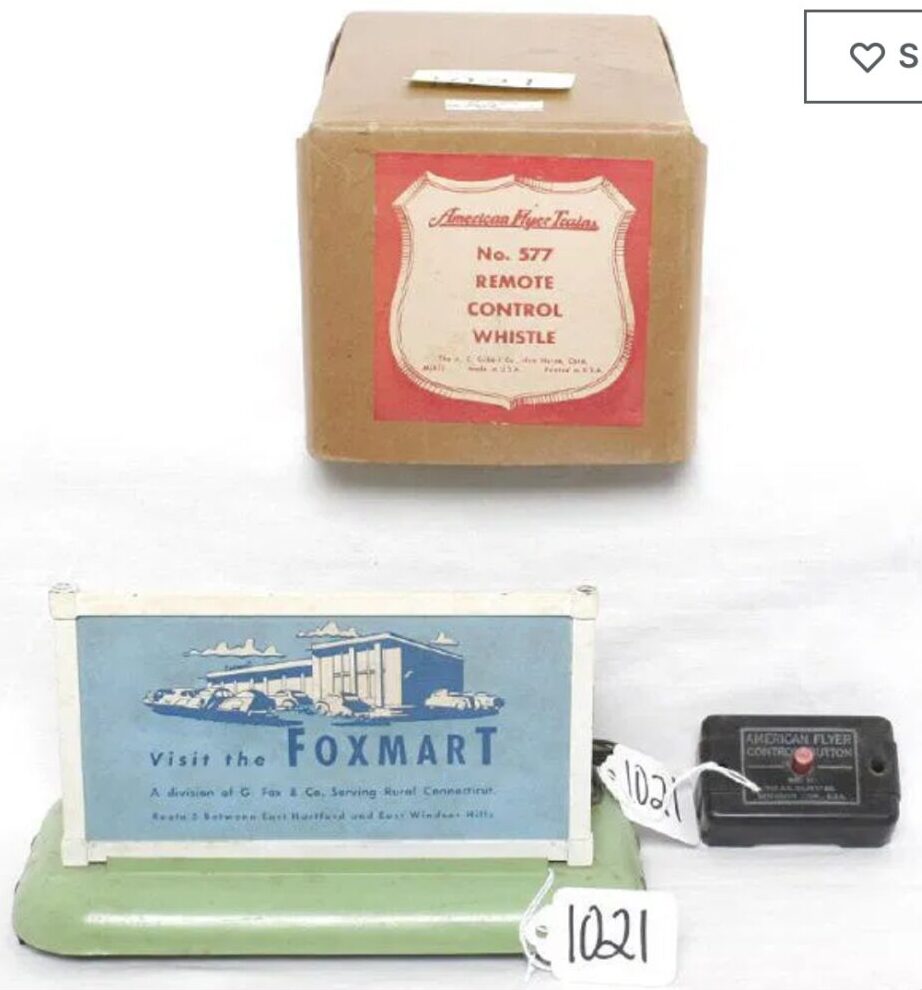
That does not mean Weaver was wrong.
In fact, there is a wonderfully simple possibility that reconciles both versions of the story.
It may have come with the set without coming in the set.
Perhaps G. Fox supplied it separately. Perhaps it was an additional promotional item accompanying the purchase. Perhaps a child left the store carrying the train while a parent carried the billboard in another package.
We simply do not know.
And I think it is important that we admit that.
Historical collecting becomes dangerous when “this is what everybody has always said” quietly transforms into “this is definitely what happened.”
Somewhere there may still be a 1947 G. Fox advertisement, Gilbert packing list, invoice, instruction sheet, or dealer circular capable of answering the question.
Until somebody finds it, the billboard gets to keep its secret.
The Cars Begin to Leave Footprints
The farther back we go, the more G. Fox history lives in collector memories, old articles and surviving objects.
As we move forward, the auction record begins leaving footprints.
And some of those footprints are remarkable.
Longtime collector John Pyfer assembled an exceptional American Flyer collection that included important G. Fox material.
When Pyfer’s collection went through Stout Auctions in 2007, the G. Fox pieces suddenly gave the hobby something extremely useful:
publicly documented prices.
On September 16, 2007, Stout offered Lot 986, an original G. Fox & Co. boxcar.
The estimate was:
$300–$3,000.
The hammer fell at:
$7,400.
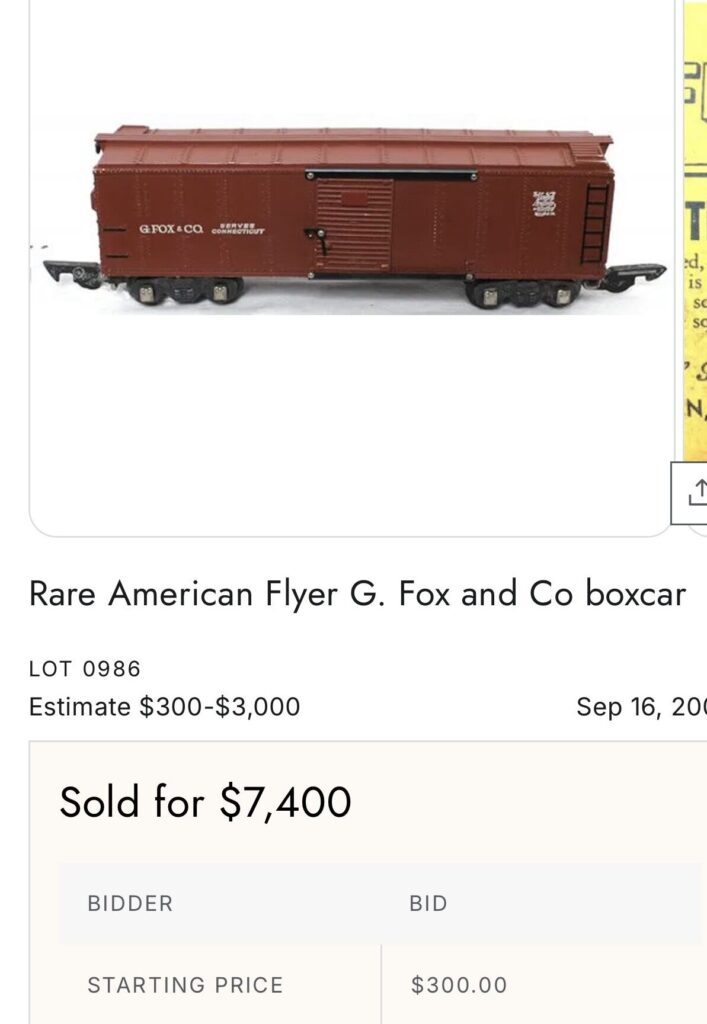
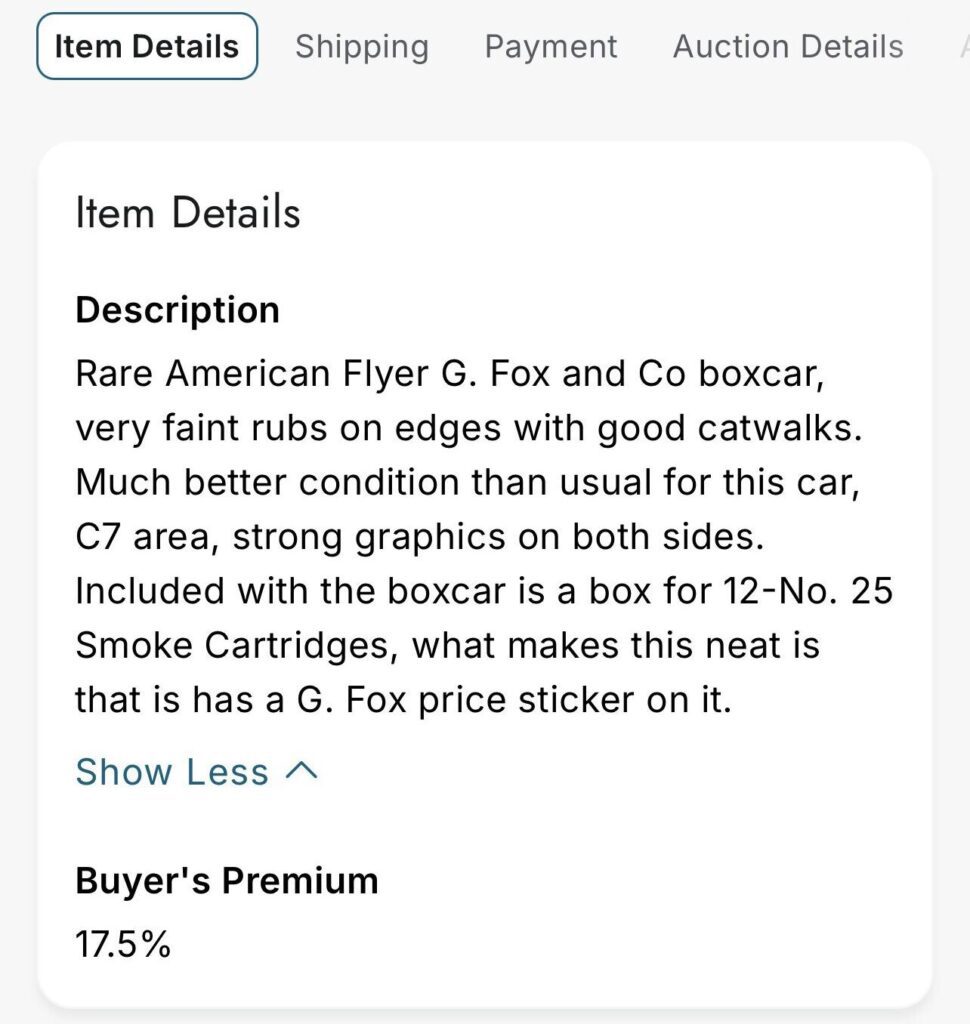
But look closely at the auction photographs, and there is another little piece of history sitting beside the car.
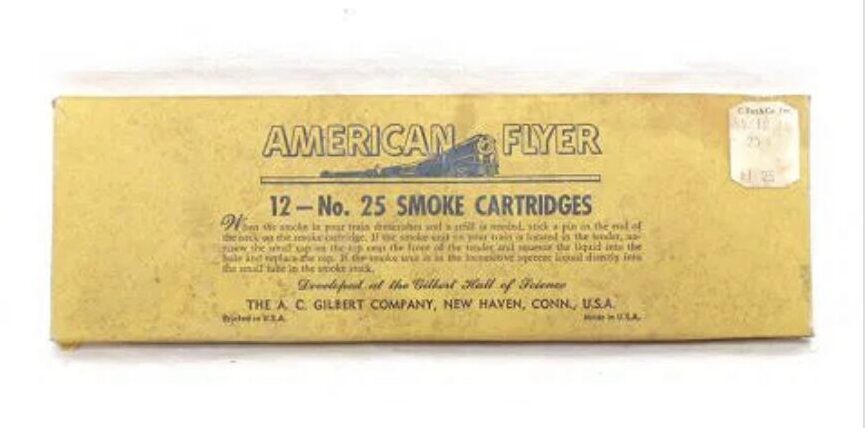
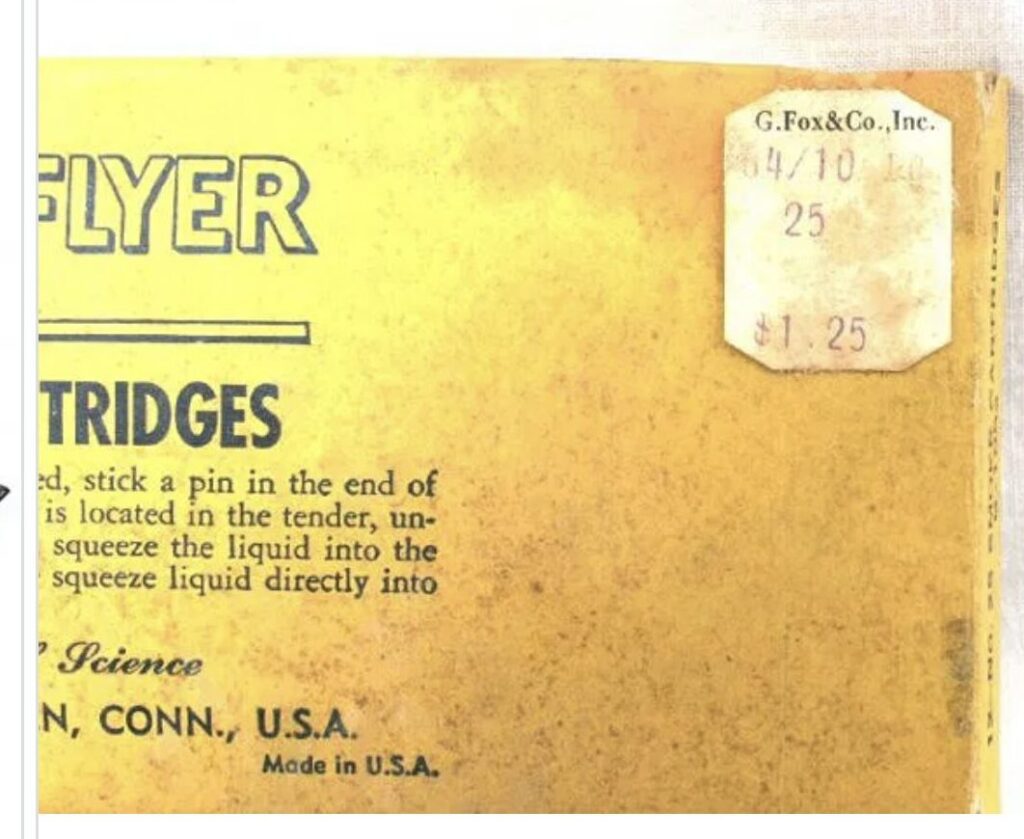
An American Flyer No. 25 smoke-cartridge package carries a genuine old G. Fox & Co., Inc. $1.25 price sticker.
It is an almost comically ordinary object sitting beside an extraordinary one.
And I love it.
Because a $1.25 department-store sticker is not collector folklore. It is a tiny physical remnant of a time when somebody could walk into G. Fox and buy American Flyer merchandise over the counter.
Sometimes history survives in the least glamorous places.
$3,500 for a Billboard
The same 2007 auction contained another treasure.
Lot 1021 was an original No. 577F Foxmart whistling billboard, complete with its original box and remote-control button.
The estimate was only $100–$1,200.
It sold for:
$3,500 hammer.
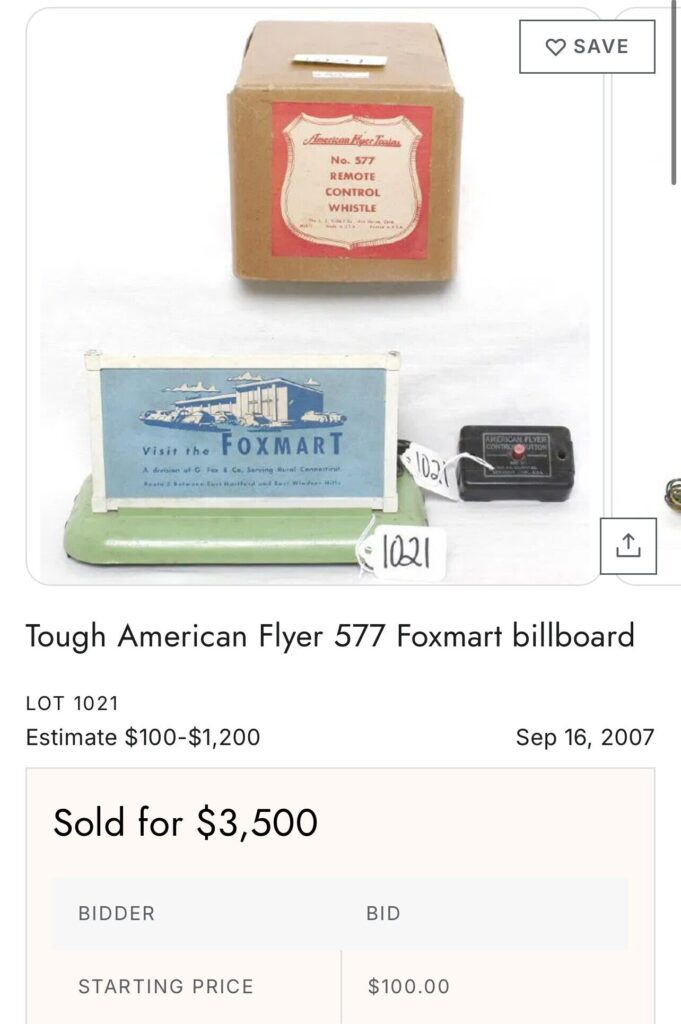
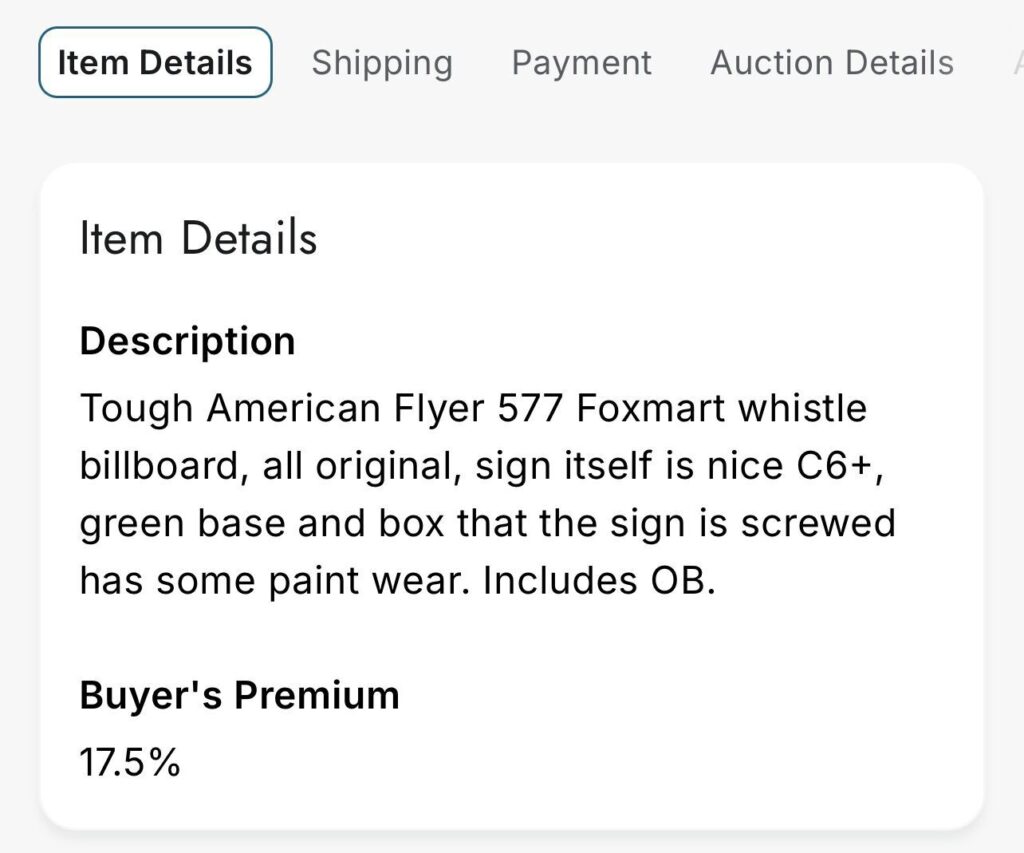
With the 17.5 percent buyer’s premium, that came to about $4,112.50 before tax.
Another G. Fox billboard appeared around 2009 through New England Toy & Train Exchange and brought $1,320 hammer, reportedly with a small blemish on the front.
Those wildly different numbers show how hard it is to assign conventional price-guide values to material this scarce.
When there are only a handful of examples, there is not really a market in the ordinary sense.
There is the object.
There are the people who want it.
And there is the question of who stops bidding first.
Following the Cars
Over the years, I have tried to maintain my own historical record of G. Fox boxcars and the collectors associated with them.
It is important to say what that record is not.
It is not a census.
It is not a claim that these are the only surviving originals.
Some of the finest toy trains in America have not been publicly offered in decades, and there are undoubtedly G. Fox cars whose existence is known only within small circles of collectors.
The American Flyer Displays & History material adds another useful reference: an original G. Fox car pictured from the Jake Jacobsen Collection, shown alongside a reproduction. G. Fox original and reproduction comparison
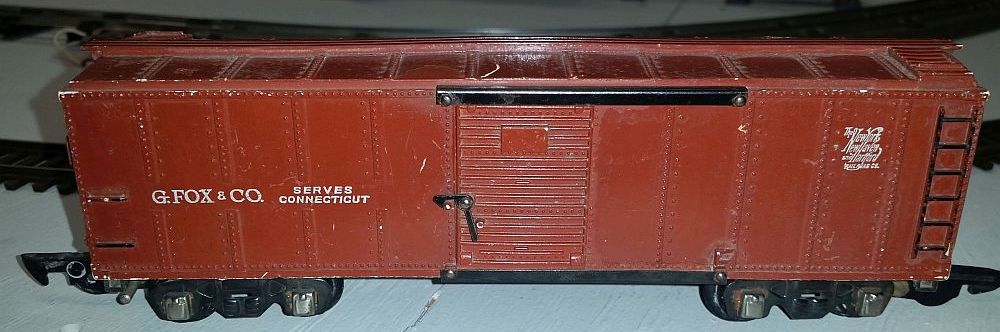
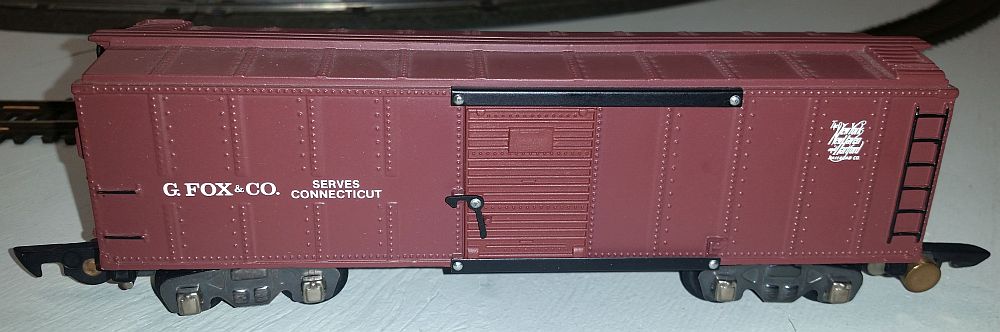
That comparison is especially useful because it illustrates differences in coloring and one small but important feature of the original lettering:
“Serves Connecticut” appears in italics on the original car.
At one time, I also had the National Toy Train Museum on my list of collections believed to contain a G. Fox.
I checked.
The museum told me it does not currently have an example.
That correction belongs in the record too.
Research is not merely accumulating information.
Sometimes it means crossing something out.
The $18,975 Example
Then came 2021.
Weiss Auctions offered an original G. Fox boxcar from the collection of respected American Flyer collector Frank Pisani.
The presale estimate was $3,000–$6,000.
The auction description identified a Tuscan-painted body molded in white, an early cast chassis, two-piece brake wheel and non-weighted couplers. It also attributed the car to a very limited 1946 set—one example of how the older 1946 date has persisted in modern descriptions.
Then the bidding began.
When it ended, the price including buyer’s premium was:
$18,975.
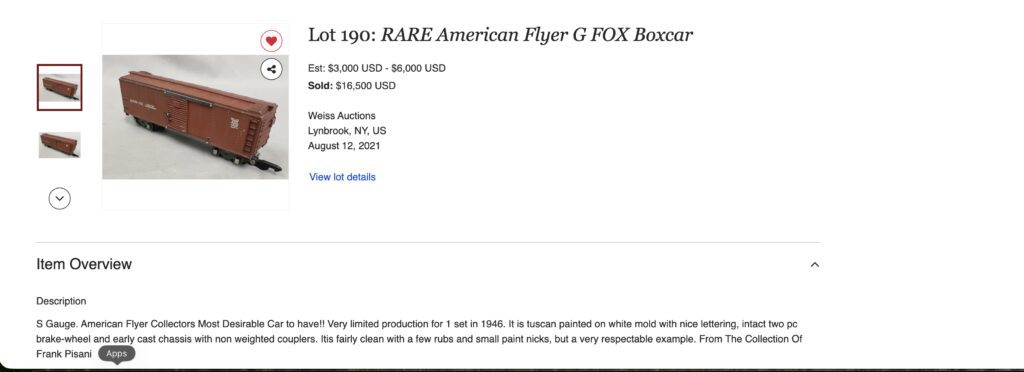
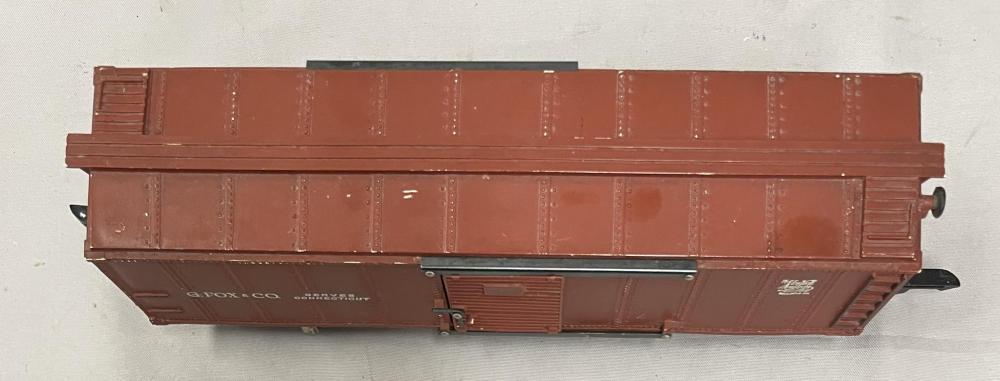
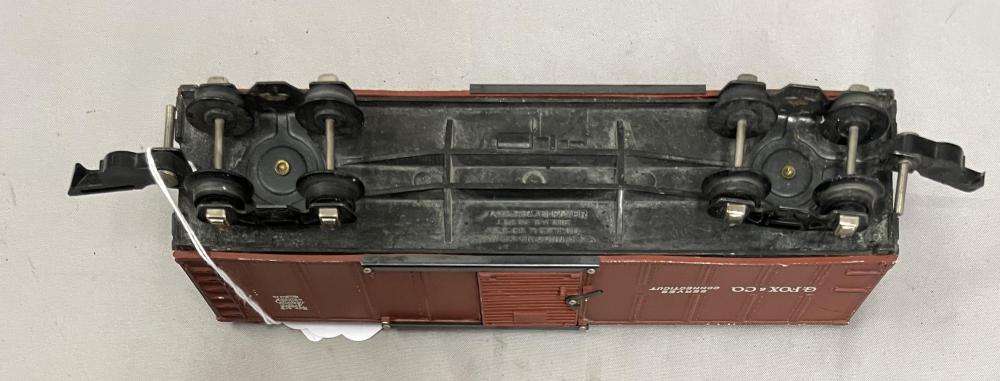
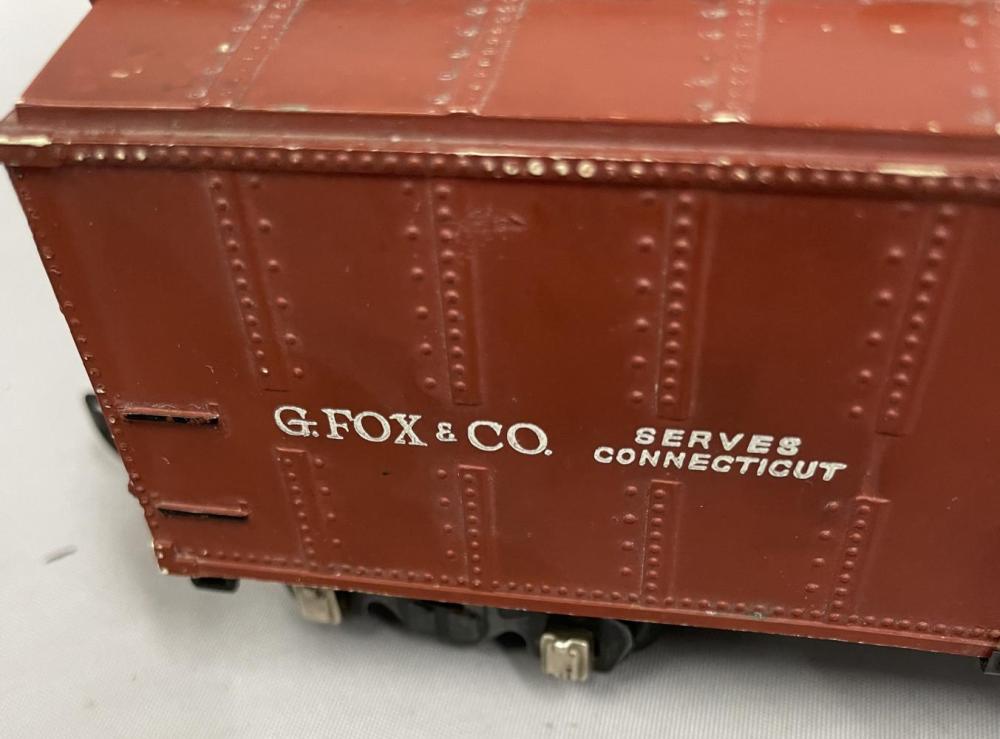
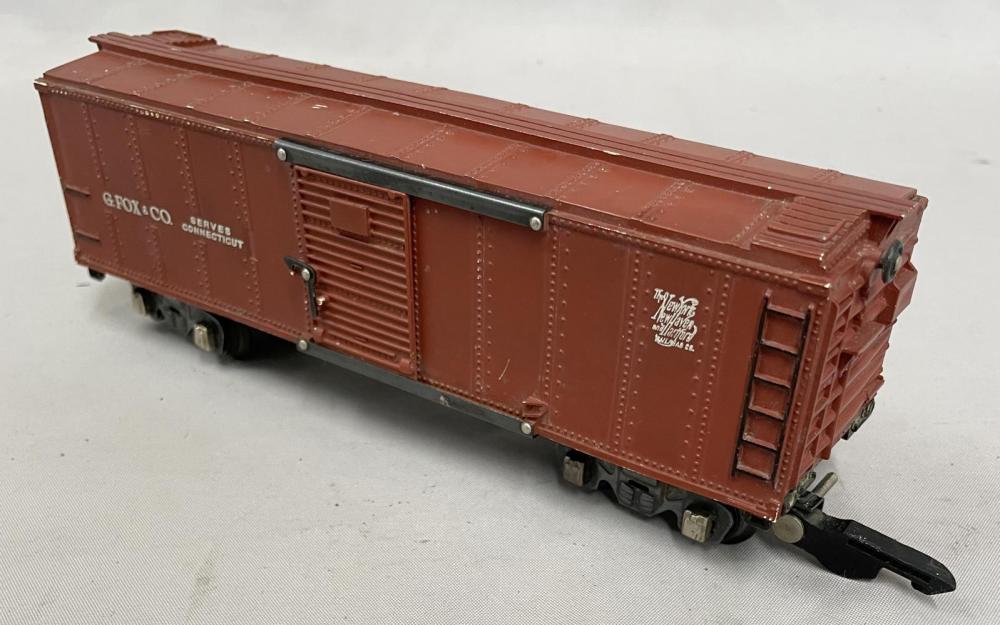
The result was reported as an auction record for the model.
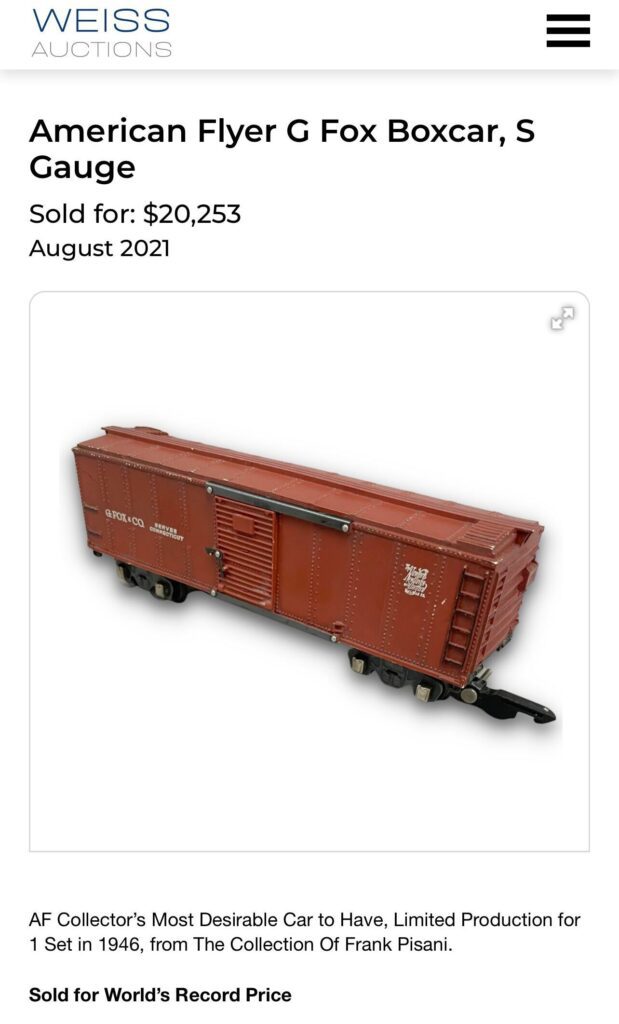
And one detail from the reporting may be more revealing than the price itself: the successful bidder had apparently been pursuing a G. Fox for decades.
Imagine wanting one particular toy train for thirty years.
Seeing one in another collection.
Hearing about one that sold.
Perhaps being a day too late.
Perhaps having the money when no car was available and seeing a car available when the money was not.
Then finally, after decades, the auctioneer reaches your number.
Collectors understand that feeling.
Everyone else thinks we are crazy.
Both groups may be right.
And Then Another One Appears
Another G. Fox appeared publicly at Stout in 2023.
Its appearance matters even though I have not yet established a reliable public final price for that particular lot. Every genuine G. Fox Boxcar that surfaces adds another photograph, another description, and another point to the historical record.
Then came September 2026.
Stout offered another original G. Fox boxcar as Lot 7622.
The estimate topped out at $6,000.
The bidding did not.
As the auction moved into Fair Warning, the number on the screen read:
$13,000.
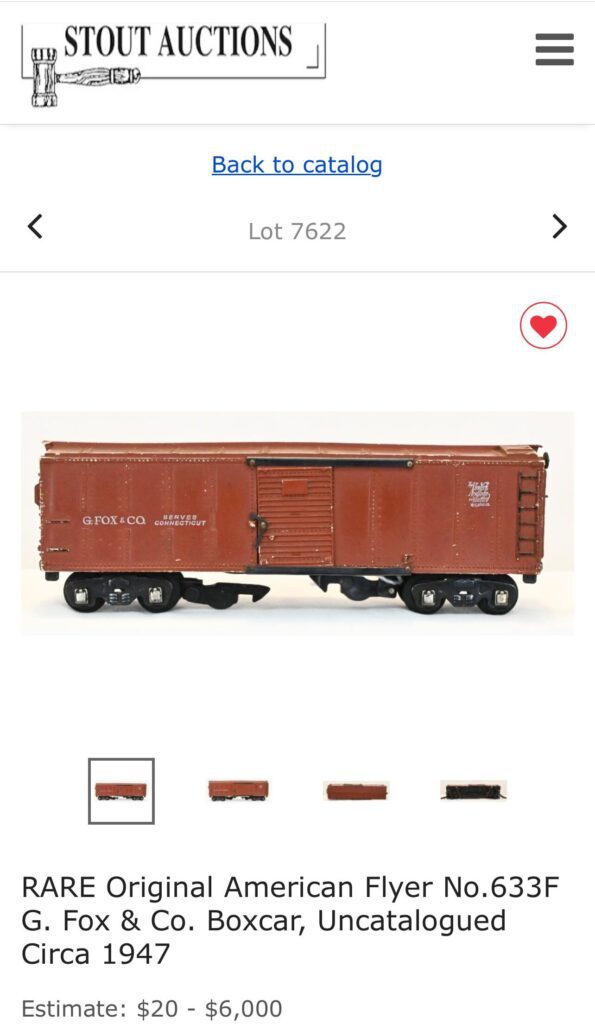
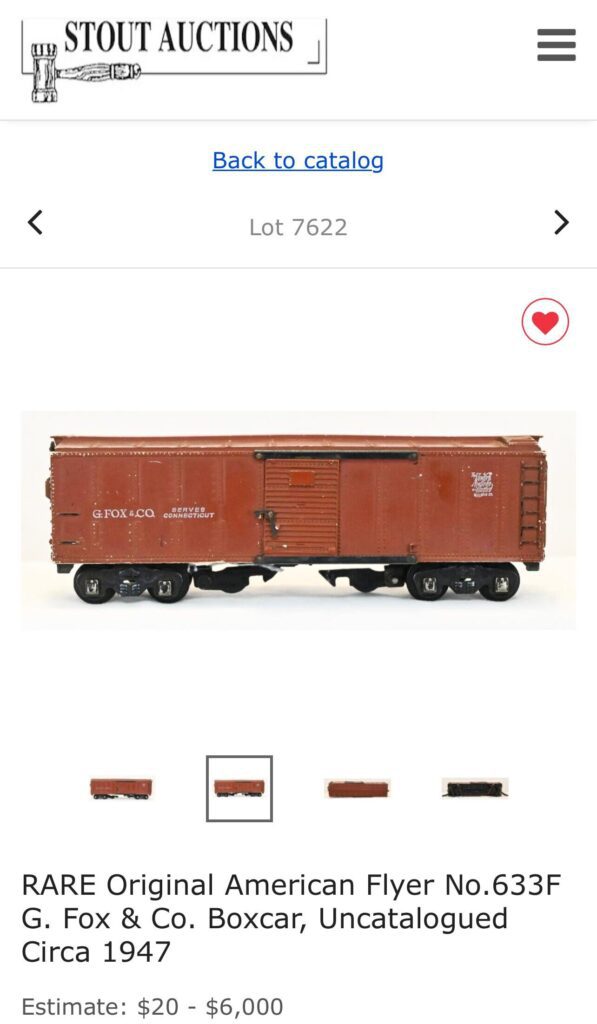
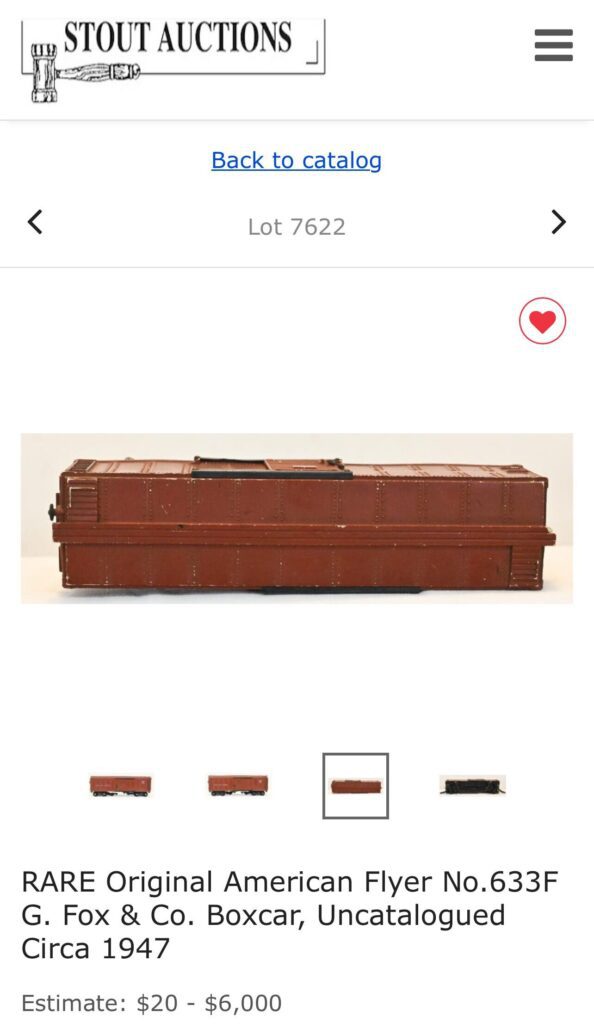
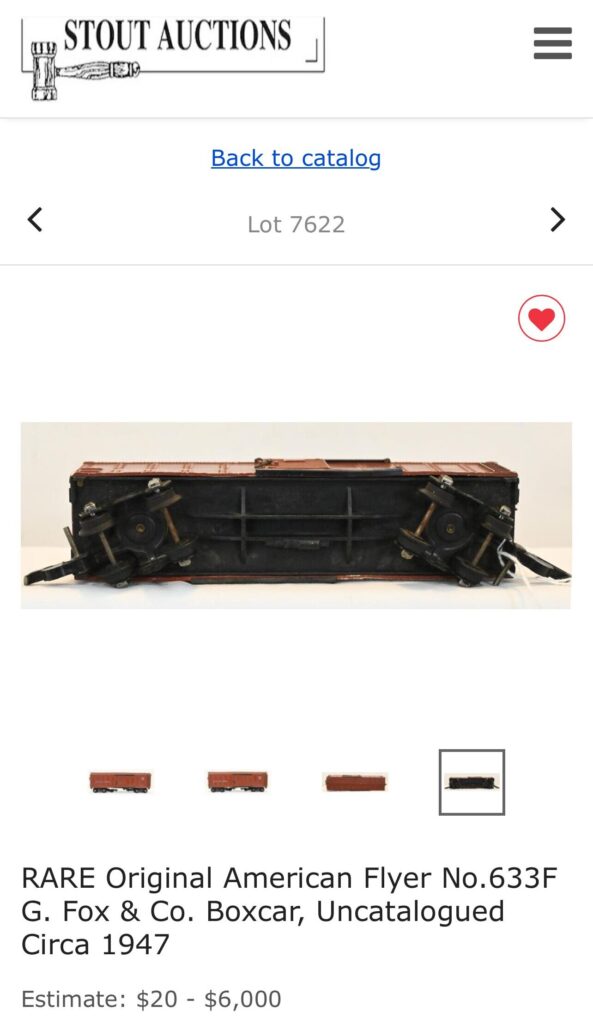
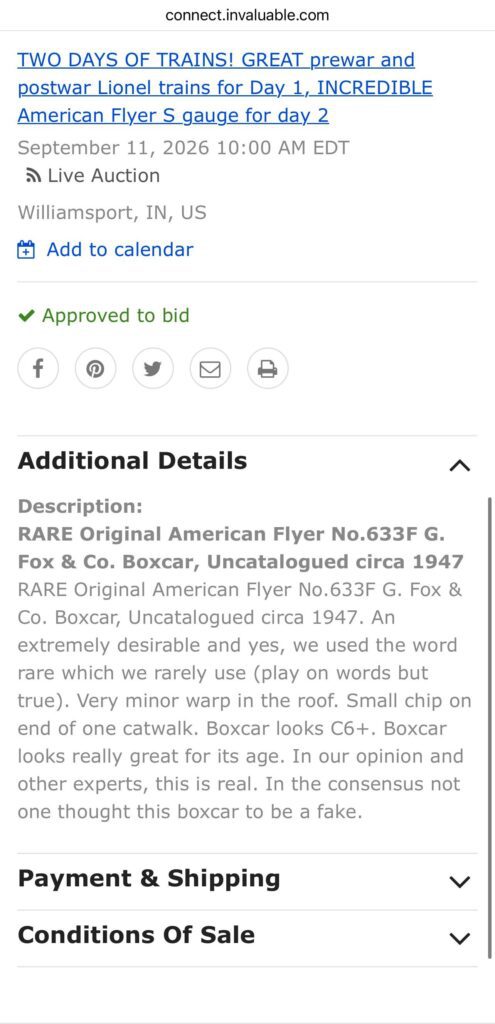
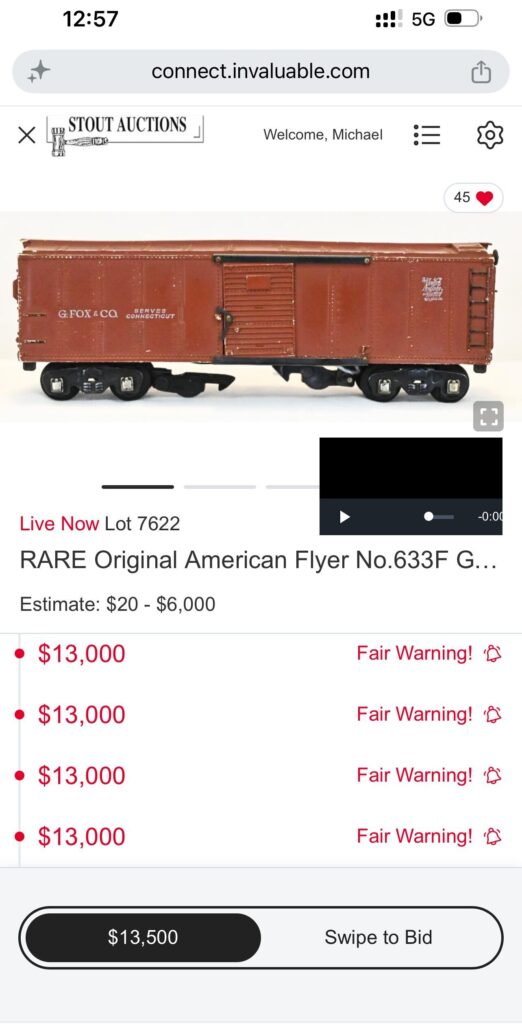
At a 19 percent online buyer’s premium, that becomes approximately $15,470, plus applicable sales tax and shipping.
Nearly eighty years after G. Fox celebrated its centennial, collectors were still fighting over that little brown boxcar to the tune of the cost of a 2017 Mercedes-Benz B-Class.
Known Documented Public Sales and Auction Appearances
This is not intended to represent every G. Fox transaction that has ever occurred. Private sales, estate transactions and older auctions undoubtedly exist outside the surviving public record.
It is the trail I have been able to document so far.
| Date | Item | Sale | Result | Notes |
|---|---|---|---|---|
| Date Unknown | Original G. Fox boxcar | AmbroseBauer | Reported $2,250 | Reported result |
| Sept. 16, 2007 | Original G. Fox boxcar | Stout, Lot 986; John Pyfer collection | $7,400 hammer | Estimate $300–$3,000 |
| Sept. 16, 2007 | No. 577 Foxmart billboard | Stout, Lot 1021; John Pyfer collection | $3,500 hammer | Original box/controller |
| c. 2009 | G. Fox/Foxmart billboard | New England Toy & Train Exchange | $1,320 hammer | Reportedly had small front blemish |
| Aug. 12, 2021 | Original G. Fox boxcar | Weiss, Lot 190; Frank Pisani collection | $18,975 incl. premium | Estimate $3,000–$6,000 |
| Nov. 18, 2023 | Original No. 633F | Stout, Lot 2500 | Result unverified | Documented public appearance |
| Sept. 2026 | Original No. 633F | Stout, Lot 7622 | $13,000 | Approx. $15,470 with 19% online premium, before tax/shipping |
Even this table requires humility.
An auction record tells us where a G. Fox was on one particular afternoon.
It does not necessarily tell us where that car went next.
And that distinction becomes important later in this story.
Rarity Creates Value. Value Creates Copies.
There is an unfortunate consequence to all of this.
There are many, many fake G. Fox boxcars floating around.
Some are obvious.
Others are considerably better.
There are also perfectly legitimate reproductions, which should not be confused with deliberate fakes. The New England Train Collectors Association later produced a G. Fox remake as a club car. It is a legitimate commemorative piece and part of the later history of the G. Fox legend.
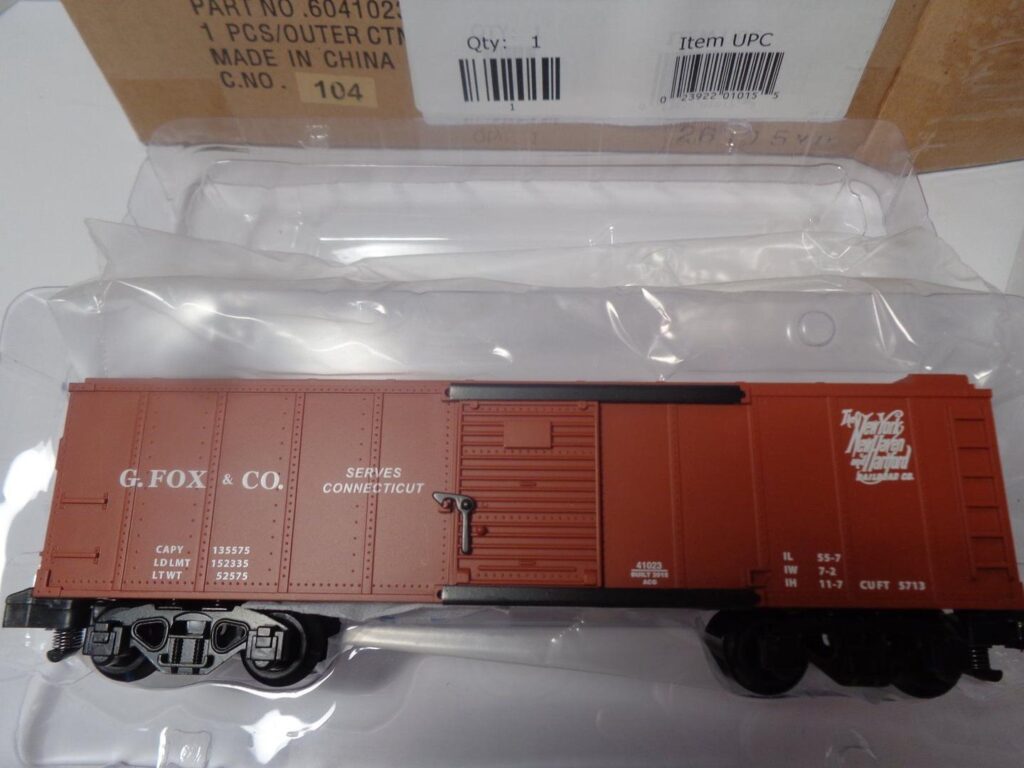
A properly represented reproduction is not the problem.
A reproduction—or an altered ordinary Flyer boxcar—eventually being represented as a genuine G. Fox boxcar is.
And when authentic cars can command five figures, the incentive becomes obvious.
The original-versus-reproduction comparison preserved by American Flyer Displays & History gives us one useful reference point. The coloring differs, and “Serves Connecticut” appears in italics on the original.
But no G. Fox boxcar should ever be authenticated by one lettering characteristic alone.
The entire car has to make sense.
The body.
The paint.
The chassis.
The couplers.
The brake wheel.
The printing.
The aging.
The wear.
And, whenever possible, the provenance.
The question should not merely be:
Does it say G. Fox?
It should be:
Does every part of this car make sense for a genuine G. Fox boxcar?
Rarity creates value.
Value creates copies.
What We Still Don’t Know
For all the years collectors have studied these things, some remarkably basic questions remain unanswered.
How many G. Fox boxcars did Gilbert actually make? The number 250 has been floated, but no one can say for sure.
How many 4605F outfits were assembled?
Did the broader promotion begin in late 1946 before the boxcar appeared in 1947?
How many complete outfits survive?
How many genuine boxcars remain?
How many Foxmart billboards remain?
Was the billboard formally part of 4605F?
Was it supplied separately?
And somewhere, buried in an archive, does a piece of G. Fox or A.C. Gilbert paperwork survive that could answer all of this?
I hope so.
Because that is the wonderful thing about historical research within a collecting hobby.
The story is never really finished.
One old photograph appears.
Somebody finds a receipt in a set box.
An elderly collector remembers a detail.
An estate brings out something nobody has seen since 1968.
A $1.25 price sticker survives.
A forgotten magazine article turns up.
And suddenly something we thought we understood becomes mysterious again.
One of Them Is Still Out There
Auction records can tell us where a G. Fox boxcar was on a particular afternoon.
They rarely tell us where it went next.
And that is where this story becomes personal.
My late father, Jay R. Oher (TCA #96-42851), spent much of his life pursuing an ambition that borders on insanity to anyone familiar with American Flyer:
One of everything Gilbert made.
It was the kind of goal that could never really be finished.
That was probably part of the fun.
Over the decades, his collection grew to roughly 1,400 pieces. Common pieces gave way to uncommon ones. Uncommon pieces gave way to scarce ones. Eventually the empty spaces represented things that some collectors might spend a lifetime merely hoping to see.
Among the rarities he acquired was one of the little brown cars at the center of this story.
An original G. Fox boxcar.
And here, dear reader, I am going to become deliberately unhelpful.
I am not going to tell you where it came from.
I am not going to connect it to a particular auction.
I am not going to identify its previous collection.
And I am certainly not going to tell you where it resides today.
I will tell you this:
It survives.
Somewhere, behind glass in an undisclosed location, my father’s G. Fox boxcar sits today.
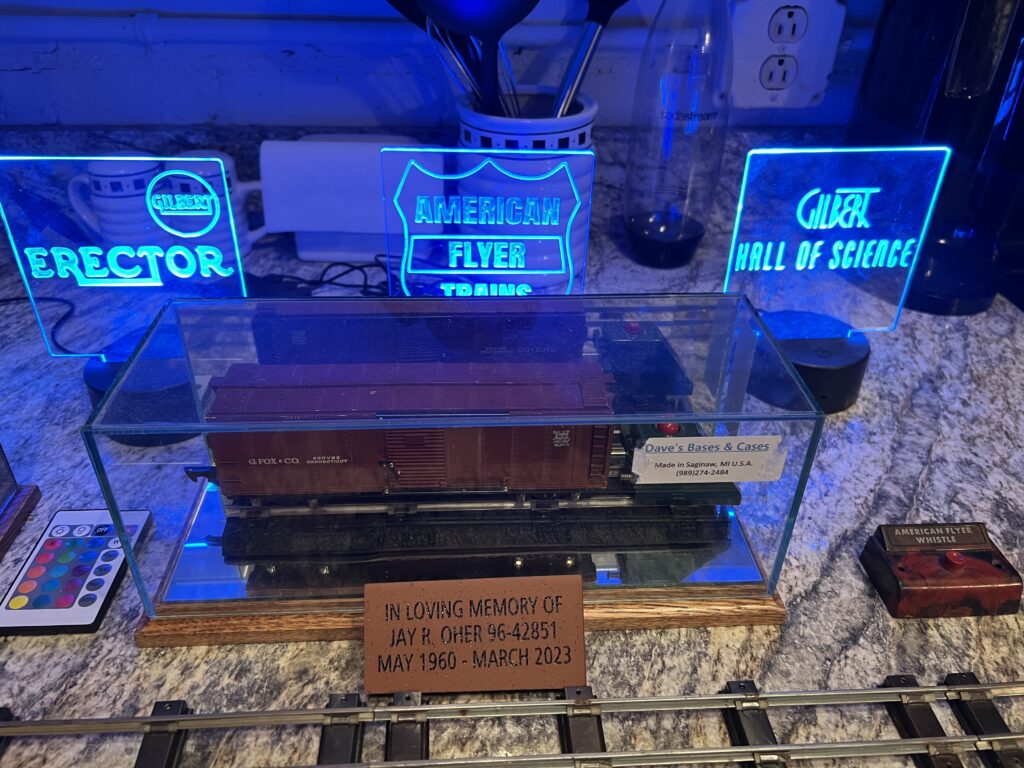
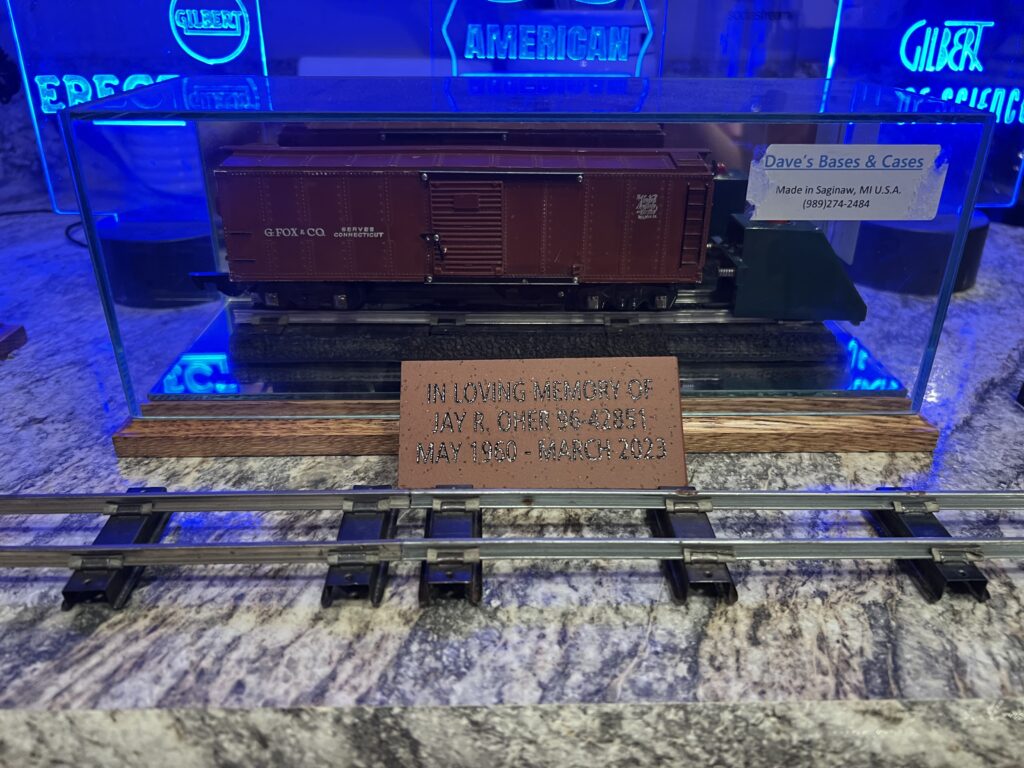
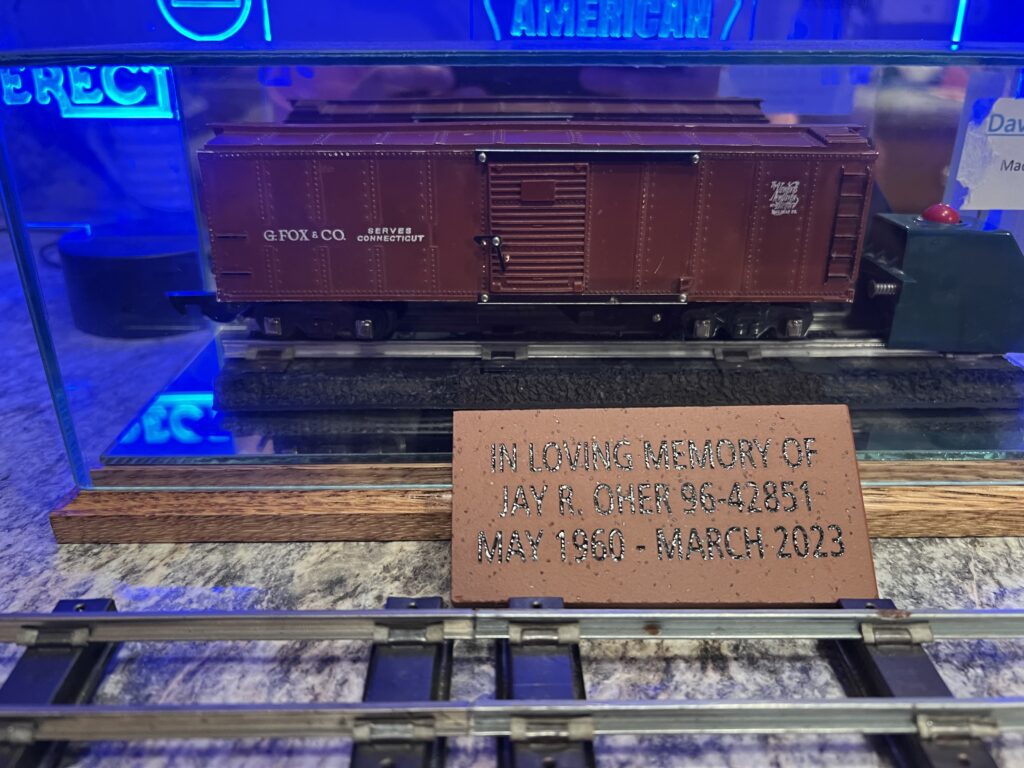
It is not buried in an attic. It has not disappeared into one of those maddening collector stories that begin, “I knew a fellow years ago who had one…”
It is real.
It is safe.
And it is loved, because it is a testament to decades of legacy and to a collection and collector, whose story will continue to be told for as long as I roam this earth.
There is something wonderfully appropriate about this.
The car itself remains almost comically modest, in my father’s own words, “The most hideous & ugly thing, that only matters because it says G. Fox & Co on it. And that is why I need one.”
A brown boxcar.
White lettering.
No elaborate mechanism.
Nothing to explain why people have chased examples for decades or why auction bidders have pushed one toward $19,000.
Just those words:
G. FOX & CO.
And behind them, nearly eighty years of history.
How many hands have held these surviving cars?
How many Christmas trees did they circle?
How many children played with one before anybody understood that it was rare?
When did somebody first look at a G. Fox boxcar and realize that this wasn’t just another American Flyer freight car?
How many have been sold quietly between collectors without ever appearing at auction?
How many times has somebody tried to buy one and heard simply:
No.
Old trains cannot answer questions like those.
Sometimes that is precisely what makes them irresistible.
I know considerably more about my father’s car than I am going to put into print.
Some provenance belongs in auction catalogs.
Some belongs in historical records.
And some can remain with the people entrusted with the artifact.
What matters here is that his G. Fox boxcar survives as something considerably more important to me than another entry on a rarity list.
It is a small monument to a lifetime spent collecting American Flyer.
The thousands of trains examined.
The York trips.
The dealers who became friends.
The pieces bought, sold, and traded.
The boxes opened with anticipation.
The obscure variations chased for years.
The knowledge accumulated one train at a time.
And the wonderfully unreasonable dream of finding one of everything Gilbert made.
That is something an auction result can never measure.
More Than a Boxcar
Perhaps Al Weaver had it right all the way back in 1983.
There really was more to G. Fox than a boxcar.
There was a great Hartford department store celebrating a century in business.
There was an American Flyer display where children once watched miniature trains circle through miniature worlds.
There was a photograph of that display preserved in Gilbert’s own literature.
There was a mysterious special outfit labeled 4605F.
There was a carton destined:
“To G. Fox & Co.”
There was a strange billboard inviting Connecticut families to Visit the Fox Mart.
There was a collector who once managed to buy a G. Fox boxcar and billboard for fifteen dollars.
There were collectors who recognized these things for what they were and preserved them for the generations that followed.
There were articles written about them.
There were rumors traded at train meets.
There were reproductions.
There were fakes.
And some originals quietly changed hands and disappeared again.
The prices tell one part of that history.
$2,250.
$7,400.
$18,975.
$13,000.
They are extraordinary numbers for a little “hideous & ugly” brown boxcar.
But ultimately they measure only what somebody was willing to pay on a particular day.
They cannot measure anticipation.
They cannot measure thirty years spent searching.
They cannot measure the feeling of opening an old box and realizing what is inside.
They cannot measure the friendships built over decades in the hobby.
And they certainly cannot measure what happens when an old train becomes intertwined with the memory of the person who collected it.
Sometimes the most valuable thing about an old train is not what somebody was willing to pay for it.
It is who once held it in their hands.
Somewhere today, an original 4605F carton still bears the words:
“To G. Fox & Co.”
Somewhere in an old black-and-white photograph, American Flyer trains are still running inside an eleven-story Hartford department store.
And somewhere else, one of those elusive brown boxcars sits silently behind glass—a testament to one man’s lifetime of American Flyer collecting.
Nearly eighty years have passed since 1947, when G. Fox celebrated its first hundred years, and Gilbert issued that extraordinary little boxcar.
The children who might once have stood mesmerized before the American Flyer display are old now, or gone.
The great department-store world they knew has largely disappeared with them.
Gilbert’s New Haven factory no longer sends American Flyer trains up the road to Hartford.
G. Fox itself is gone.
The display is gone.
The salesmen are gone.
The A.C. Gilbert Company is gone.
But the trains remain.
That, perhaps, is why we collect them.
Not because they allow us to go backward.
They cannot.
But because occasionally an old cardboard box, a faded $1.25 price sticker, a black-and-white photograph, a mysterious billboard—or four little words printed on the side of a toy freight car—can bring that vanished world surprisingly close again.
For a moment, perhaps, we can almost see the lights in the toy department.
Almost hear the trains running.
Almost imagine Hartford in 1947, when G. Fox was celebrating its first century, and American Flyer was still helping children dream.
And somewhere tonight, one of the most elusive boxcars in American Flyer history is doing exactly what it has done for nearly eighty years.
Waiting.
Quietly carrying its story.
I know where that one is.
And that’s ALL I’m going to say. 😏