Hiding in Plain Sight: Factory Prototypes in the 1956 Lionel Accessory Catalog
By Philip K. Smith, TCA #82-17298 Fall 2024 e*Train
Occasionally, a toy train catalog holds a little mystery.
For example, the illustration of The Ives Railway Circus in the 1928 and 1929 catalogs includes a mysterious “sixth car,” apparently a white passenger car unrelated to Ives’ white trains.
The Lionel 1946 Advance Catalog lists a 2626 Observation Car that was not produced or included in the consumer catalog. It was named SAGER PLACE after the street by the factory in Irvington, New Jersey.
In 1946, the Lionel Consumer catalog included two sets with a 703 semi-scale Hudson, listed for separate sale on page 12. That Hudson was not manufactured.
In 1952, New Super Speedliner aluminum cars made their debut. However, the 2534 was called the SILVER PLATTER, and the SILVER BLUFF was numbered 2533 but was actually 2534.
These little mysteries are few and far between, yet there is one exception—a BIG exception!
The Lionel 1956 Accessory Catalog does not look exciting. It is printed on pulp paper. Illustrations are gray with a few muted colors. It is the polar opposite of the 1956 consumer catalog. It is easily overlooked. Yet a closer look reveals some surprises.
The cover highlights a boy exclaiming, “Gee Pop… You got ’em! Now how about The NEW LIONEL ACCESSORIES.”

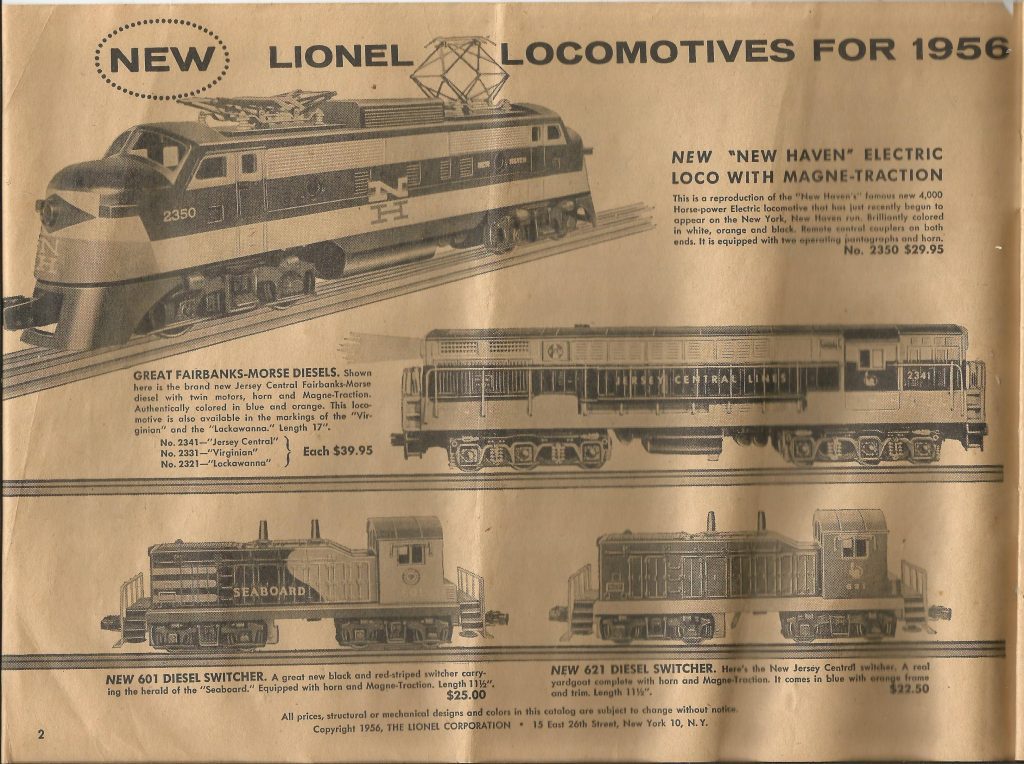
Between the red lines of copy is a 2350 New Haven EP-5. But it looks different. There are air vents and portholes like a Lionel F3 diesel. These are obvious on the 3/4 view on page 2. Apparently, two F3 A-units were cut apart but not in half. The vertical cut begins near the rear cab and carefully follows the body to provide a cab on each end. The illustration on Page 2 does not look as sleek as the EP-5 in the consumer catalog. That alone makes this catalog unusual. But that is just the beginning.
Below the EP-5 is the new 2341 Jersey Central FM TrainMaster. A Jersey Central herald on the cab; the number (2341) to the right on the hood. That was changed in production.
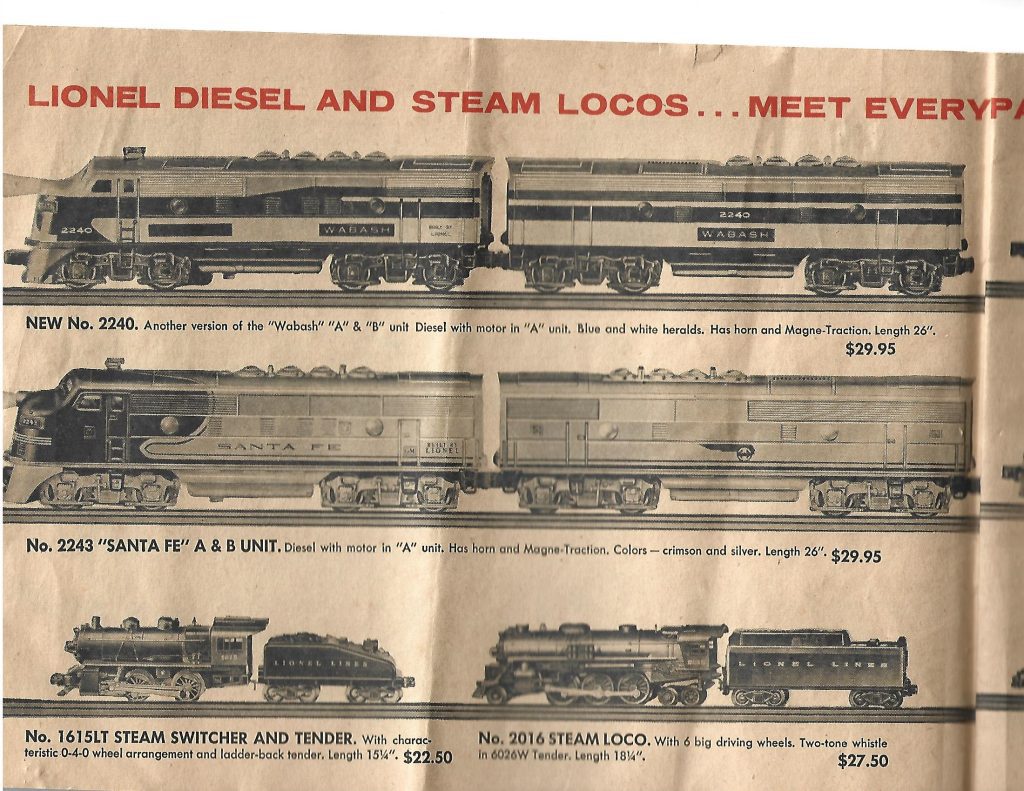
On Page 4 is the new 2240 Wabash A and B unit. In the white stripe to the right of the ladder is a black rectangle. WABASH is printed in another rectangle to the rear. The blue stripe curves up on the A-unit.
On Page 6 is a 2338 Milwaukee GP-7 with an orange stripe through the cab and a number on the step below the handrail to the left of the cab.
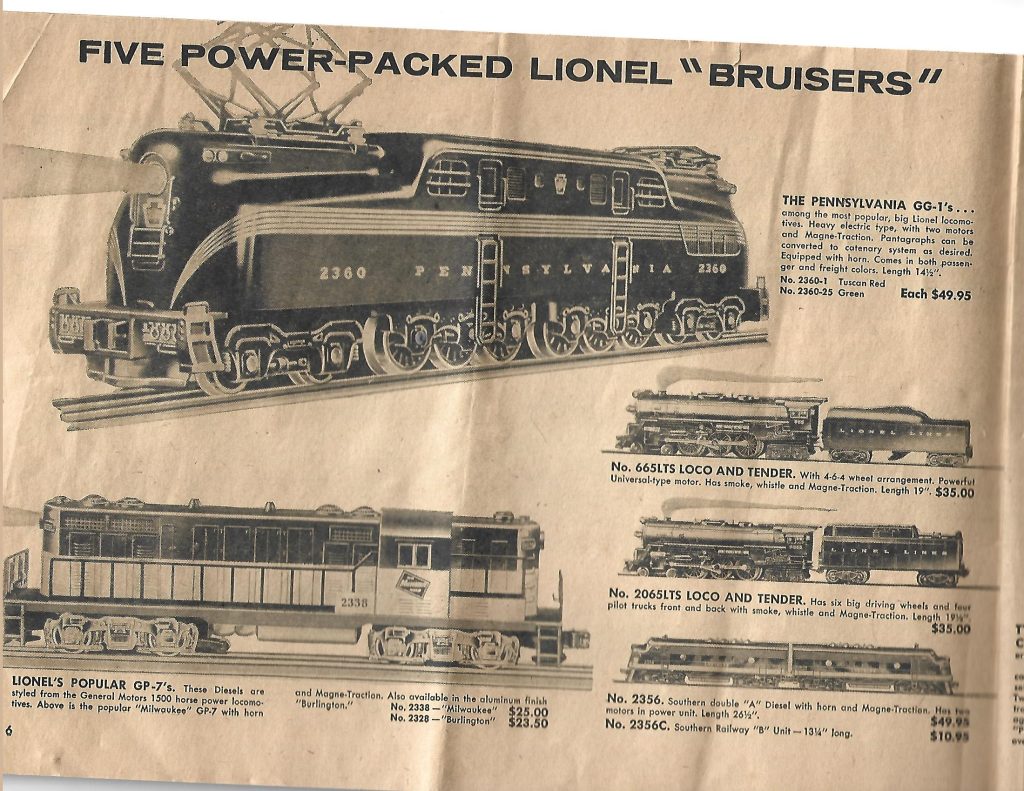
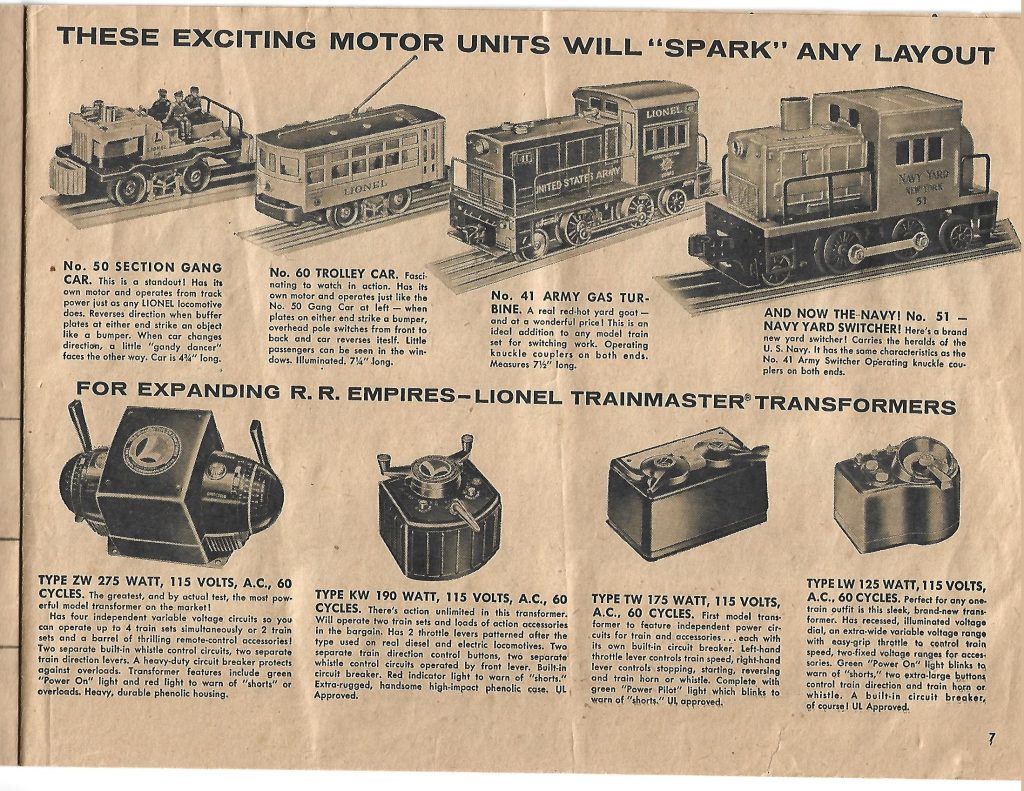
On page 7 is a 60 Trolley Car with big wheels and a center brake rod and brake shoes like the 50 Gang Car on the left.
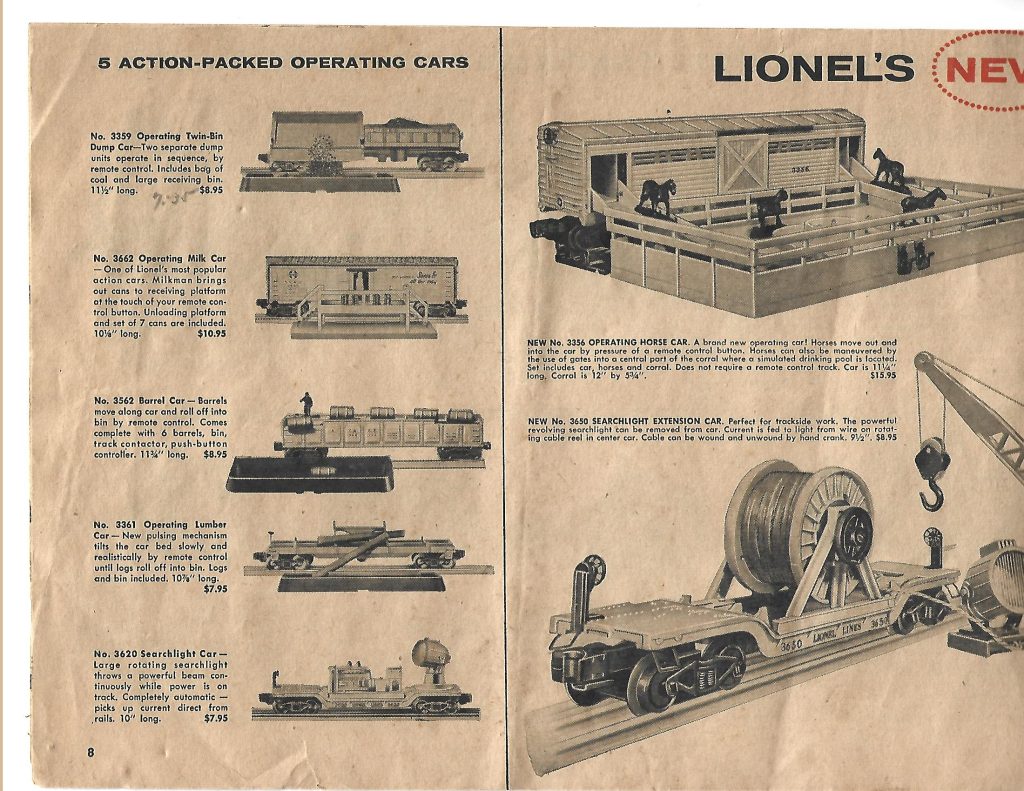
On Page 8 is a 3662 Operating Milk Car with Santa Fe lettering like a 6672 Reefer but no Instrument Panel at the bottom left.
The NEW 3356 Operating Horse Car has no lettering, a white or gray body, and a small number to the right of the door.
Below that, the NEW 3650 Searchlight Extension Car has a round handwheel on the cable reel axle.
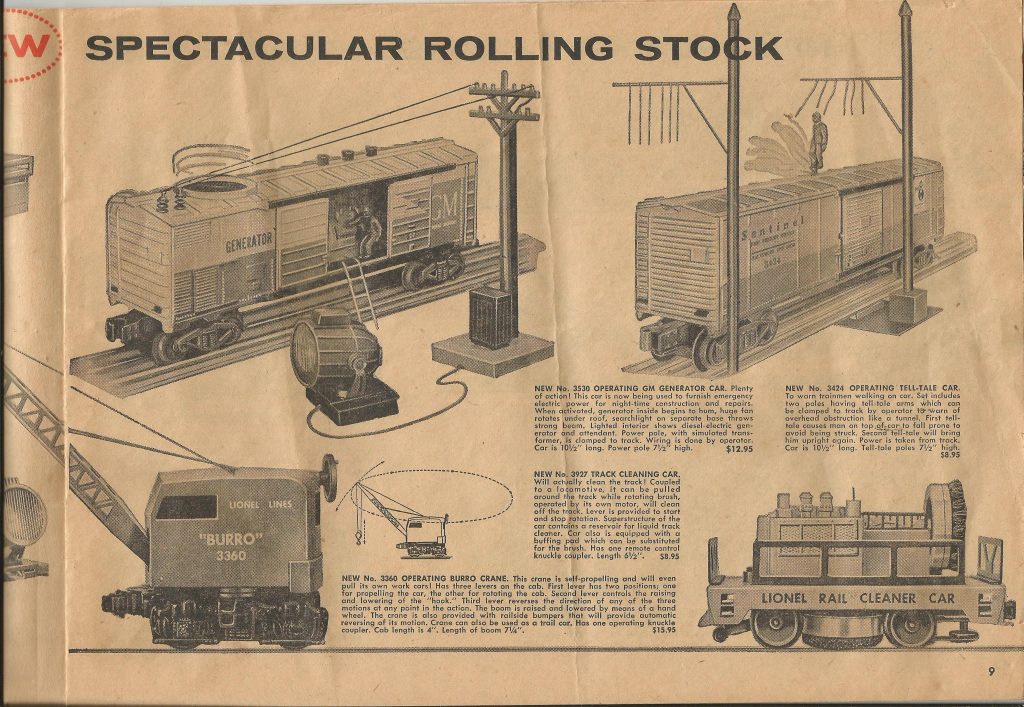
At the top of Page 9 is a new 3530 Operating GM Generator Car. The upper half and the roof are gray or white. To the right is a new 3424 Operating Tell-Tale Car in a B&O Sentinel scheme. At the lower left is a new 3360 Operating Burro Crane on an F-3 truck. The new 3927 Track Cleaning Car is lettered LIONEL RAIL CLEANER CAR. Underneath is a brush. At the back is a buffing pad.
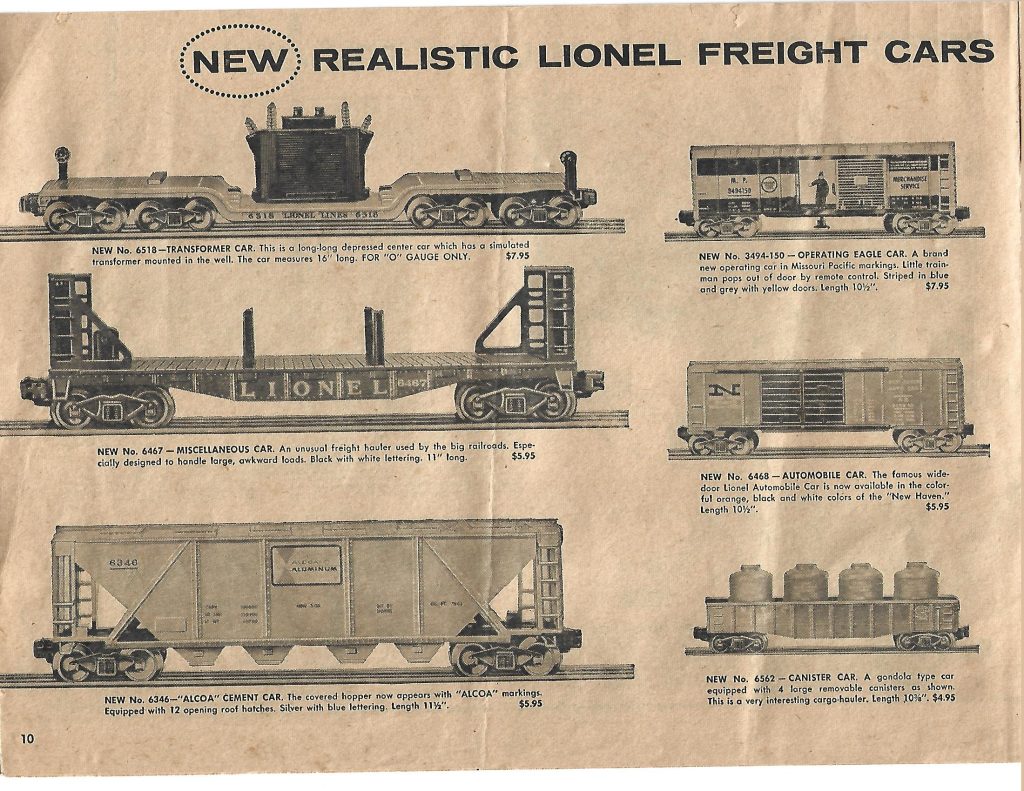
At the upper right of Page 10 is a new 3494-150 Operating Eagle Car with lettering different from the production model.
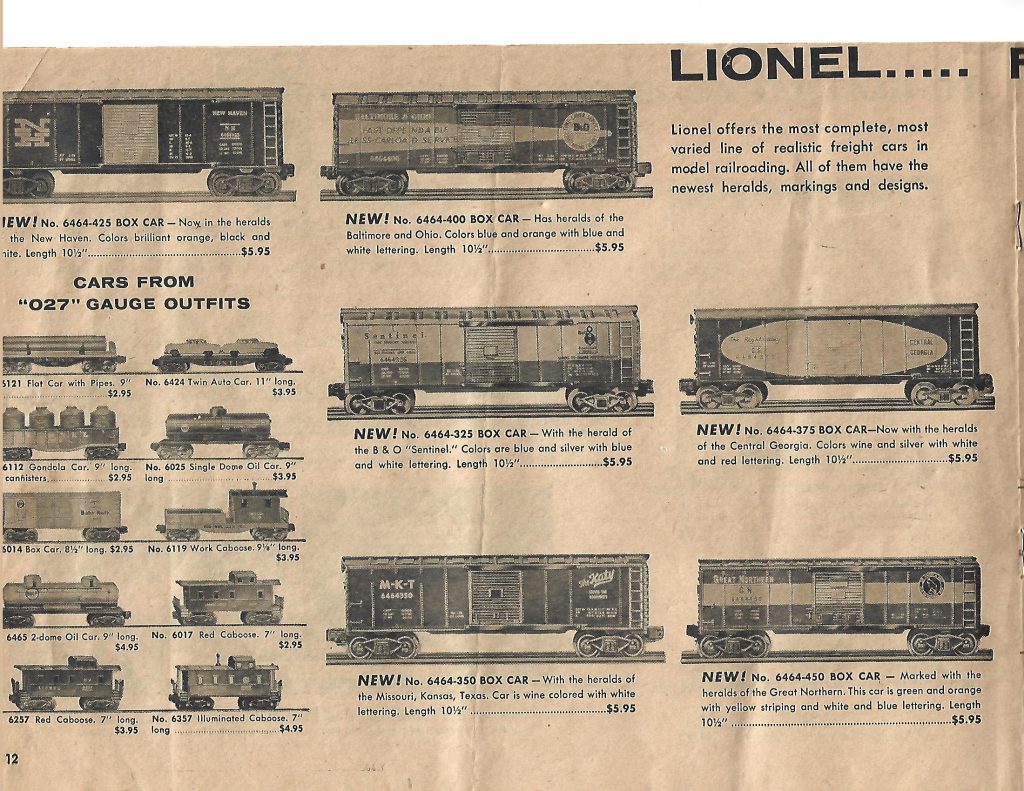
On page 12 is a new 6464-325 B&O Sentinel boxcar. The lettering matches the new 3424 Operating Tell-Tale Car.
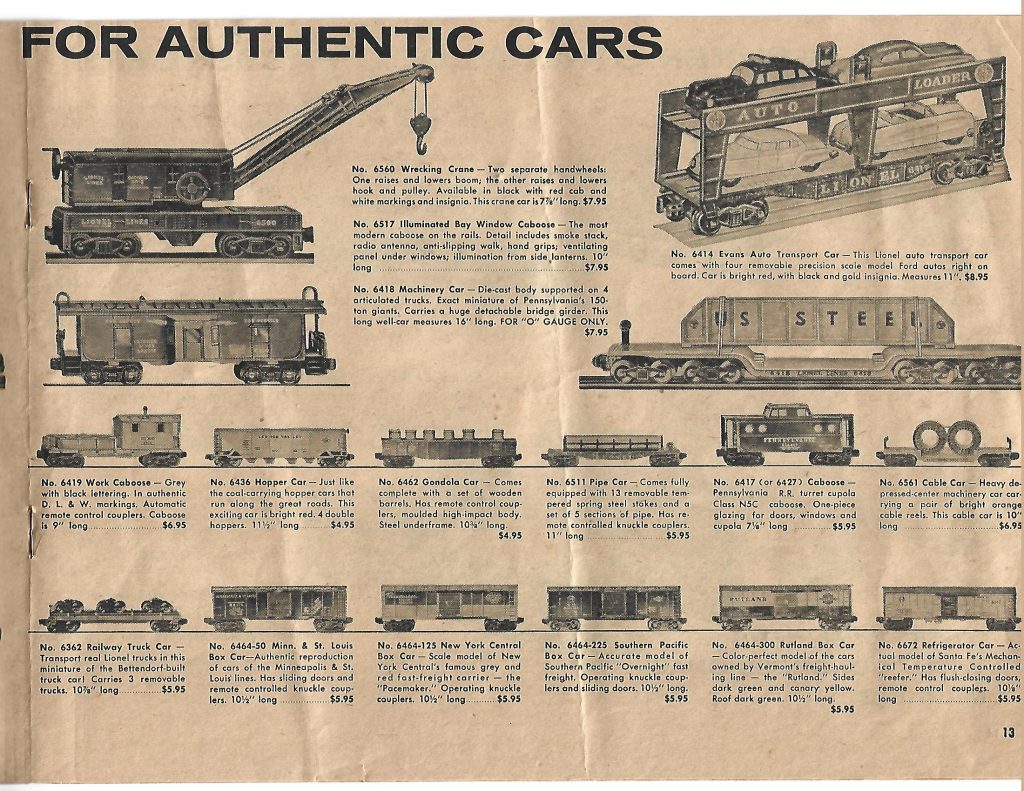
On page 13, the 6414 Evans Auto Transport Car has a more rugged superstructure than the production model. Autos are different, too. One is a taxi. Two extensions at the top hint at some type of unloader.
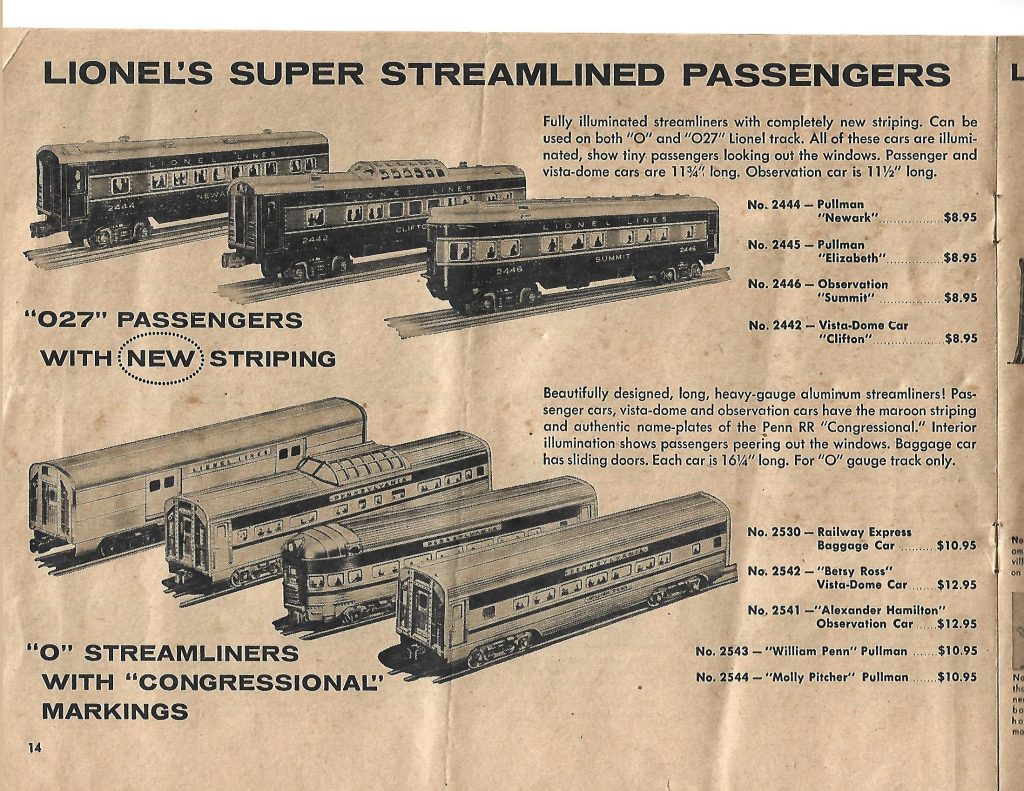
On Page 14, SUPER STREAMLINED PASSENGERS are different. The 2442, 2444, 2445, and 2446 have light stripes and dark sides, the opposite of red-striped cars. Below them, CONGRESSIONAL cars have PENNSYLVANIA nameplates in the middle of the upper stripe and small nameplates below a narrow stripe under the windows. The 2530 Railway Express Baggage Car has large doors.
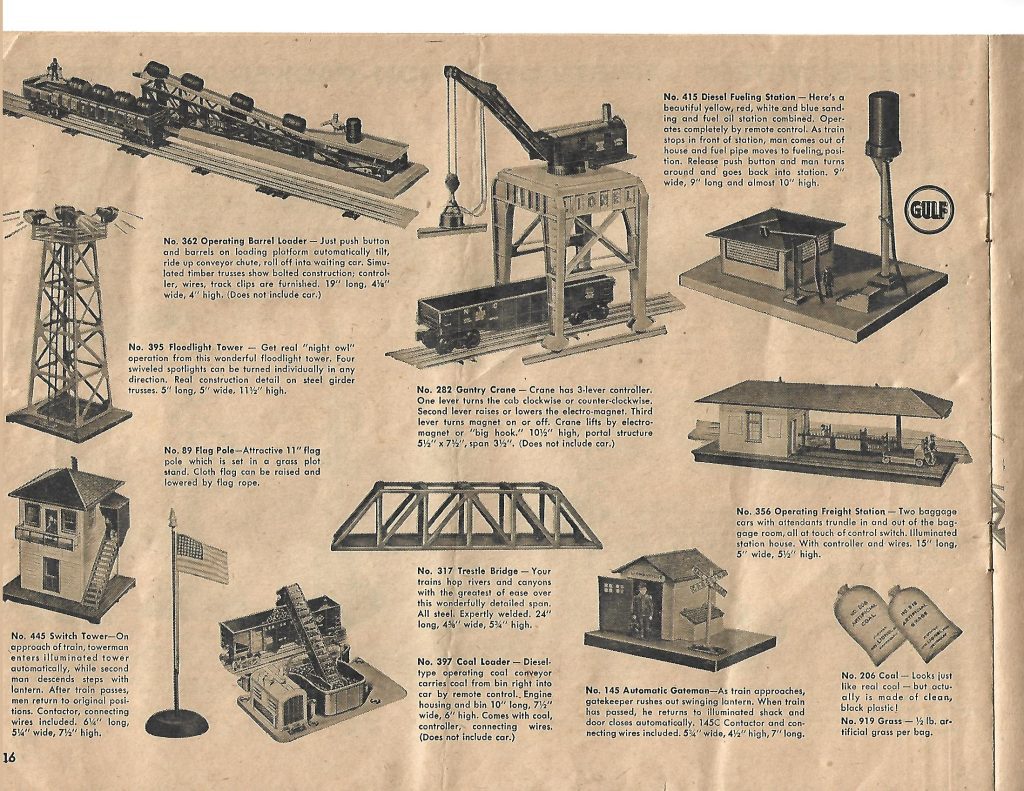
On Page 16, the 356 Operating Freight Station has a more detailed baggage cart.
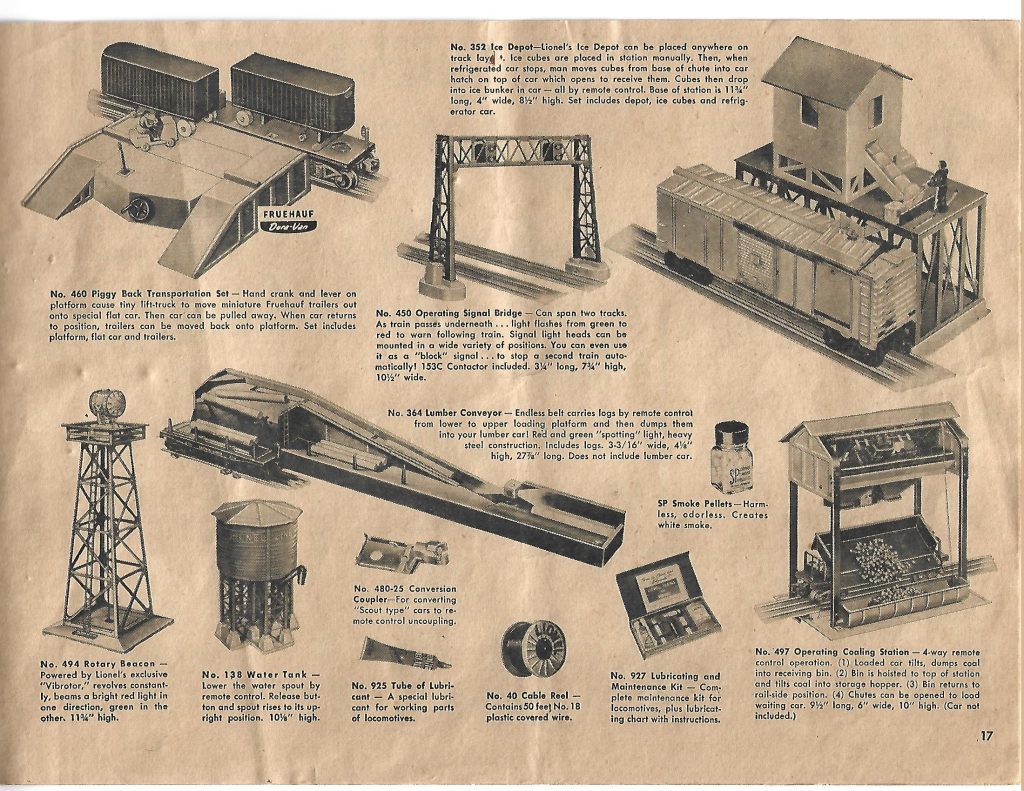
At the upper right of page 17, the 352 Ice Depot has no rear ice chute. The 6352 Reefer is blank. The door on the side to remove the ice cubes looks rough, as though it had been cut from the side of the car.
Then come pages of layout plans.
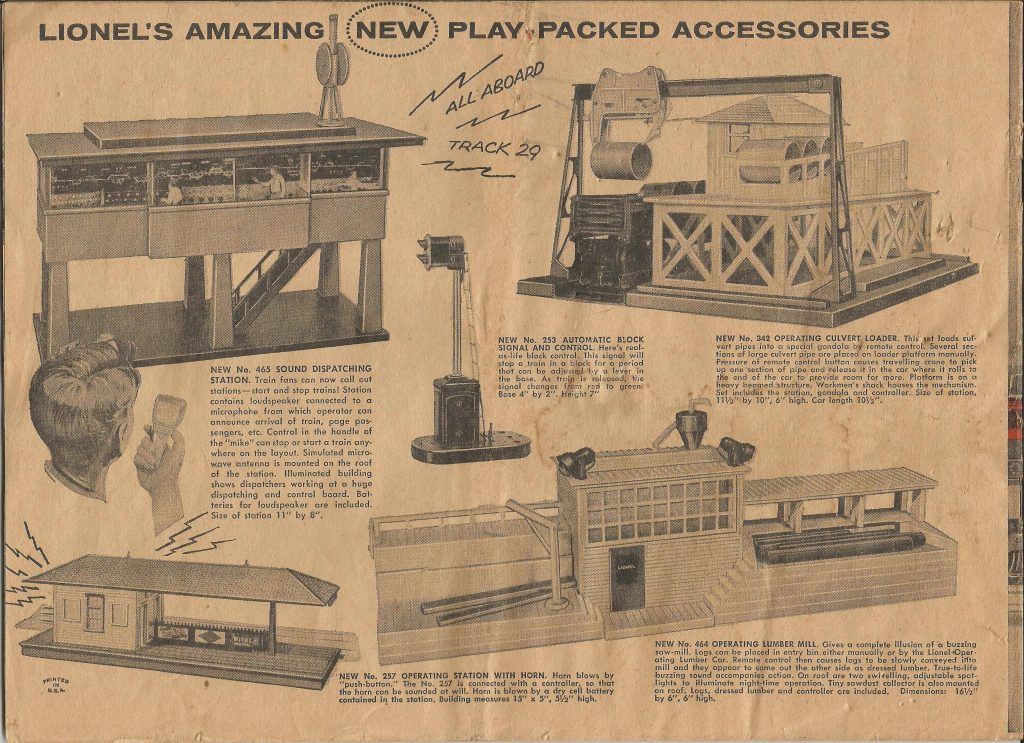
On the back cover is a new 465 Sound Dispatching Station with no lettering. To the right is a NEW 342 Operating Culvert Loader. The building behind the ramp resembles the building on an American Flyer 779 Oil Drum Loader. A lattice base supports the ramp and building, not a concrete base. At the lower right is a NEW 464 Operating Lumber Mill with two spotlights like those on a 395 Floodlight Tower, one at each end of the roof.
The 1956 Lionel Accessory Catalog, often overlooked due to its plain appearance, is a treasure trove of hidden gems. Beneath its unassuming exterior lies a collection of prototype models that offer a fascinating glimpse into Lionel’s design process. From modified locomotives to unique cars and accessories, these prototypes reveal the innovative spirit and experimentation that characterized Lionel’s development.
While the consumer catalog showcased the final products, the accessory catalog provides a behind-the-scenes look at the creative ideas that didn’t make it to mass production. For collectors and enthusiasts, this catalog offers a rare opportunity to explore the evolution of Lionel’s iconic trains and accessories.