Heritage Engines
By Robert J. Buehler, TCA #12-67826 Fall 2025 e*Train
The discussion of Heritage Engines must begin with railroad paint schemes. Railroads have long used distinctive paint designs to commemorate special events, honor organizations or families, recognize community service, or simply make their locomotives stand out.
Norfolk Southern was the first railroad to launch a full Heritage Unit program in 2012, celebrating its 30th anniversary. The idea was to paint 20 new locomotives in the color schemes of its predecessor railroads. Since the 1820s, hundreds of railroad companies have been created, merged, reorganized, and consolidated into the major systems we know today. Norfolk Southern itself was formed in 1982 from the merger of the Southern Railway and the Norfolk & Western Railway.
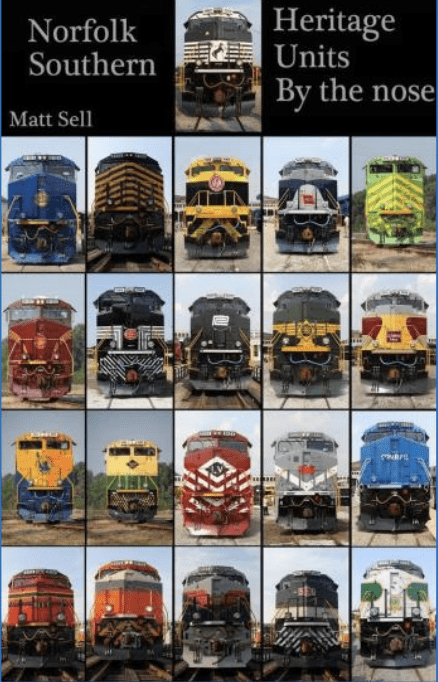
The first Norfolk Southern Heritage Unit, Conrail 8098, rolled out of Altoona, Pennsylvania, on March 15, 2012. The final unit of the series, Lackawanna 1074, debuted on June 27 of that same year. The GE ES44AC locomotives were painted in Altoona, PA, and Chattanooga, TN, while the EMD SD70ACe units were painted at Progressive Rail Services in Muncie, IN. Today, these Heritage Units operate in freight service across Norfolk Southern’s 19,500-mile, 22-state network.
Following Norfolk Southern, CSX began its own Heritage Unit program a few years later, also honoring the railroads it had absorbed through mergers and acquisitions. The Atlantic Coast Line name first appeared in 1871, with the railroad officially incorporated in 1900. Its routes stretched from Georgia to Richmond, Virginia, and later expanded into Florida. In 1960, the ACL opened a new headquarters in Jacksonville, Florida—a building that remains the current CSX headquarters today.
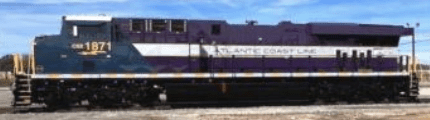
In 1967, the ACL merged with the Seaboard Air Line Railroad to form the Seaboard Coast Line, which later became part of the CSX Corporation. “We do a lot of research on the colors and the schemes just to make sure that we get it right,” explained Jeromy Hutchison, a CSX carman painter. “We want to make sure we do our heritage justice.” All CSX heritage paint schemes have been designed and applied at the locomotive shop in Waycross, Georgia. The design approach features modern CSX styling on the front of the locomotive, which transitions into historic colors and logos toward the rear. For example, CSX 1871 carries the ACL paint scheme across the railroad’s 20,000-mile network, celebrating employee pride and preserving the company’s legacy while continuing to provide safe, reliable, and sustainable rail service.
No other railroad has honored its history quite like Union Pacific. Its preserved heritage fleet reflects the company’s strong commitment to both its legacy and its role in America’s story. The fleet dates back to 1912, with many passenger cars built during the golden age of rail travel. Each car is unique, telling a different chapter of Union Pacific’s history. Over more than a century, these trains have carried U.S. presidents, senators, generals, soldiers, artists, architects, entertainers, and other influential figures.
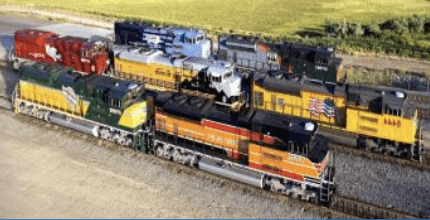
Union Pacific has created only 17 commemorative locomotives in its more than 150-year history. Some honor predecessor railroads that became part of today’s Union Pacific, while others recognize important organizations in American society.
And of all heritage locomotives, none is more famous than Union Pacific Big Boy 4014. Twenty-five Big Boys were built exclusively for UP, beginning in 1941. Measuring 132 feet long and weighing 1.2 million pounds, these locomotives were so large that their frames were articulated—or “hinged”—to handle curves. They featured a 4-8-8-4 wheel arrangement: four pilot wheels, two sets of eight driving wheels, and four trailing wheels. The Big Boys typically operated between Ogden, Utah, and Cheyenne, Wyoming.
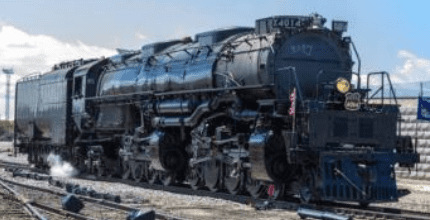
Big Boy 4014 was delivered in December 1941 and retired in December 1961 after logging 1,031,205 miles in just 20 years. In 2013, Union Pacific reacquired the locomotive from the RailGiants Museum in Pomona, California, and brought it back to Cheyenne for a multiyear restoration. It returned to service in May 2019 to celebrate the 150th anniversary of the completion of the Transcontinental Railroad.